Any manufacturing or service business in India can get Udyam (MSME) registration if it is within the limits. From 1 April 2025, a micro enterprise has up to ₹2.5 crore in plant, machinery or equipment and up to ₹10 crore turnover. Small goes up to ₹25 crore and ₹100 crore. Medium goes up to ₹125 crore and ₹500 crore. Registration is free.
- Udyam registration is the government's registration for micro, small and medium enterprises (MSMEs). It is done online at udyamregistration.gov.in.
- There is no fee for filing Udyam registration.
- You need an Aadhaar number. You also need PAN, and GSTIN if your business must have GST registration.
- You do not upload any documents. Registration is on self-declaration.
- One enterprise can have only one Udyam registration.
What is Udyam (MSME) registration?
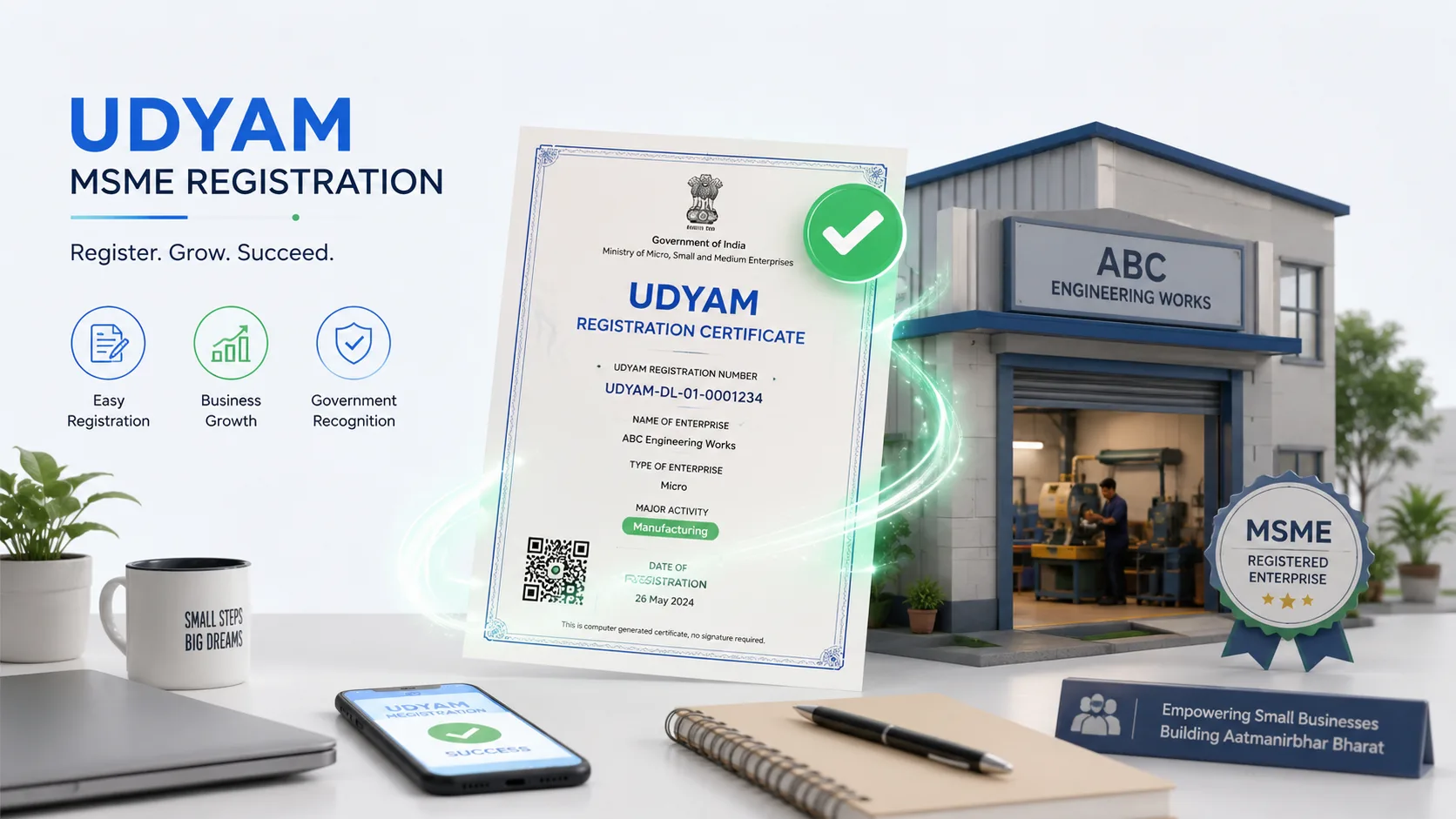
MSME means micro, small and medium enterprises. Udyam registration is how a business tells the government it is an MSME. The registration gives a Udyam Registration Number and a Udyam Registration Certificate.
Banks use the category shown on your Udyam certificate when they treat your loan as an MSME loan (RBI MSME FAQ, Q1).
The law behind it is the Micro, Small and Medium Enterprises Development Act, 2006 (MSMED Act). Under section 8 of the Act, a micro or small enterprise may file at its own choice. A medium enterprise that makes or produces goods must file.
Who is eligible for MSME registration?
You are eligible if your business:
- makes goods, or provides services, and
- is within the limits for at least the medium category (table below).
Proprietors, partnership firms, HUFs, companies, LLPs, co-operative societies, societies and trusts can all register. The Udyam portal lists the Aadhaar needed for each type (see "Details you need" below).
Traders. Retail and wholesale traders can register on Udyam, but only for priority sector lending from banks (RBI circular, 7 July 2021). They do not get the other MSME benefits such as the government purchase benefits (DC-MSME FAQ, Q18 and Q49).
MSME limits from 1 April 2025
A business must be within both limits for its category: investment and turnover.
| Category | Investment in plant, machinery or equipment | Annual turnover |
|---|---|---|
| Micro | Up to ₹2.5 crore | Up to ₹10 crore |
| Small | Up to ₹25 crore | Up to ₹100 crore |
| Medium | Up to ₹125 crore | Up to ₹500 crore |
Source: Union Budget 2025-26 (PIB, 1 February 2025), notified on 21 March 2025 with effect from 1 April 2025 (Udyam portal circulars).
Old limits (before 1 April 2025), for anyone checking an older certificate:
| Category | Investment | Turnover |
|---|---|---|
| Micro | Up to ₹1 crore | Up to ₹5 crore |
| Small | Up to ₹10 crore | Up to ₹50 crore |
| Medium | Up to ₹50 crore | Up to ₹250 crore |
As of 9 October 2026: Parliament passed the MSMED (Amendment) Bill, 2026 in August 2026. It lets the government set the limits by notification and makes Udyam filing voluntary for every MSME. Its changes start only on dates the government notifies. The newest limits notice on the Udyam portal is still the one dated 21 March 2025. We will update this page if new limits are notified.
How MSME classification works
- Investment is the money in plant, machinery or equipment. It is linked to your income tax return (ITR). A new business with no ITR yet uses a self-declaration.
- Turnover does not count exports of goods or services.
- Moving up. If you cross either limit for your category, you move to the next category up.
- Moving down. You move down only when you fall below both limits for your current category.
Source for all four points: RBI circular on the MSME definition, 2 July 2020.
Example (our reading). A service business has ₹40 lakh of equipment and ₹12 crore turnover. Investment is within micro, but turnover is above ₹10 crore. It is a small enterprise.
Details you need for Udyam registration
Udyam registration is paperless. The Udyam portal says no documents or proof need to be uploaded. You still need these details ready:
| Detail | Whose |
|---|---|
| Aadhaar number | Proprietor (proprietorship), managing partner (partnership), karta (HUF), or authorised signatory (company, LLP, co-operative, society, trust) |
| PAN | The business (or the proprietor) |
| GSTIN | Only if your business must be registered under GST |
| Investment and turnover figures | Pulled from government records linked to PAN and GSTIN, where available |
| Business details | Name, address, type of activity |
Source: Udyam portal, "Important" notes.
How to register on Udyam
Register on the official portal, udyamregistration.gov.in. Some private websites look like it, so check the web address before you enter your Aadhaar or pay anything.
You give the Aadhaar number of the right person (see the table above), the PAN of the business, and the GSTIN if your business must have one. Investment and turnover figures are taken from government records linked to your PAN and GSTIN where they exist. You do not upload any documents, and there is no fee. When you submit, you get a Udyam Registration Number and certificate.
If you file false details or hide facts, you can be penalised under section 27 of the MSMED Act.
Can I register for MSME without GST?
Yes, if your business does not need GST registration. GSTIN is needed only where the CGST Act requires it (MSME notification S.O. 1055(E), 5 March 2021). If your turnover is under the GST threshold and nothing else makes GST registration compulsory, you can register on Udyam with PAN and Aadhaar.
To check whether you need GST, read our GST registration turnover limit guide.
Very small businesses that have no GST registration can also use the Udyam Assist Platform (next section).
Udyam Assist Platform for informal micro businesses
The Udyam Assist Platform is run by SIDBI. It is for informal micro enterprises that are not registered with GST. They register with the help of a Designated Agency, such as a bank, NBFC, micro-finance institution or government department. The certificate it gives is treated like a Udyam certificate for priority sector lending. It was launched on 11 January 2023. (SIDBI)
Udyog Aadhaar is now Udyam
Udyog Aadhaar (UAM) was the older MSME registration. It was replaced by Udyam registration from 1 July 2020. Anyone with an Udyog Aadhaar or an older EM-II registration must register again on the Udyam portal. The government extended the validity of old Udyog Aadhaar registrations a few times. The last extension listed on the Udyam portal ran to 30 June 2022.
After you register
- You can print your certificate, update your details and check a Udyam number on the same portal. See Udyam certificate download, verify and update.
- There is no renewal. The Udyam portal says there is no need for renewal of registration, but you must update your details each financial year.
- A Udyam certificate shown through DigiLocker is accepted (Udyam portal circular, 1 January 2025).
Buyers must pay a registered micro or small supplier within 45 days of acceptance. See the MSME 45 days payment rule.
To see what registration gets you, read MSME registration benefits.
Want help with Udyam registration? See our MSME registration service.
Frequently asked questions
What is the MSME turnover limit in 2026?
From 1 April 2025, the turnover limits are up to ₹10 crore for micro, ₹100 crore for small and ₹500 crore for medium. As of 9 October 2026, no newer limits are listed on the Udyam portal. Exports are not counted in turnover.
How to check MSME eligibility?
Compare your investment in plant, machinery or equipment and your turnover (without exports) with the table above. You must be within both limits of a category. If you are within the medium limits, you are eligible.
Who is eligible for MSME registration?
Any business that makes goods or provides services and is within the medium limits. Proprietors, firms, HUFs, companies, LLPs, co-operatives, societies and trusts can register. Traders can register for bank lending purposes only.
Can I register MSME without GST?
Yes, if your business is not required to have GST registration. GSTIN is needed only where the CGST Act requires it.
How much money is required for MSME registration?
Nothing. The government charges no fee for Udyam registration.
What is the investment limit for a micro enterprise?
Up to ₹2.5 crore in plant, machinery or equipment, from 1 April 2025.
What documents are required for MSME registration?
No documents are uploaded. You need the Aadhaar number of the right person, the PAN of the business, the GSTIN if you must have one, and your business details.
Is MSME registration mandatory?
Under section 8 of the MSMED Act, it is optional for micro and small enterprises. A medium enterprise that manufactures goods must file. You need it to claim MSME benefits.
Can I have two Udyam registrations with one PAN?
No. An enterprise can file only one Udyam registration. If you do more than one activity, such as manufacturing and services, you add them to the same registration.
What happens if my turnover crosses the limit?
If you cross either limit, you move to the next category up. You move down only when you fall below both limits of your current category.
Is MSME the same as Udyam?
Yes. Udyam registration is the registration for MSMEs. Udyam replaced Udyog Aadhaar from 1 July 2020.
I have an old Udyog Aadhaar. Is it still valid?
Holders of Udyog Aadhaar had to register again on the Udyam portal. The last validity extension listed on the portal ran to 30 June 2022.
Can a trader get MSME registration?
Yes, retail and wholesale traders can register on Udyam, but only for priority sector lending from banks. Government purchase benefits are not for traders.
Hinglish mein sawaal
MSME registration kaise kare?
udyamregistration.gov.in par jaiye, Aadhaar aur PAN daliye, business ki details bhariye aur submit kariye. Koi fees nahi lagti aur koi document upload nahi karna hota.
MSME kya hai aur limit kitni hai?
MSME matlab micro, small aur medium enterprise. 1 April 2025 se micro ki limit ₹2.5 crore investment aur ₹10 crore turnover hai.
Last reviewed: 10 October 2026
FilingSetu is the brand of ANR Consultancy, a partnership firm.
GSTIN: 07ACOFA0324K1ZG
This page explains the law as it stands on the review date. It is not advice on your specific case.