Input tax credit is one of the biggest advantages of the GST system, but it's also where most businesses trip up. The concept is simple: don't pay tax on tax you've already paid. The execution? That's where the details matter.
- ITC lets you offset GST paid on purchases against GST collected on sales.
- Four conditions under section 16 must all be met — invoice, receipt, supplier paid, return filed.
- If an invoice isn't in your GSTR-2B, you cannot claim the credit.
- Section 17(5) blocks ITC on cars, client food, personal use and more.
Every rupee of GST you pay on business purchases, raw materials, office supplies, software, professional services, is potentially recoverable as input tax credit. But “potentially” is doing a lot of work in that sentence. Let's look at how ITC actually works, what blocks it, and how to make sure you get every rupee you're entitled to.
The basic mechanism
ITC works like a chain of credits flowing through the supply chain:
- You buy raw materials for ₹1,00,000 + 18% GST = ₹1,18,000. You've paid ₹18,000 in GST.
- You manufacture a product and sell it for ₹2,00,000 + 18% GST = ₹2,36,000. You collect ₹36,000 in GST.
- You deposit only the difference with the government: ₹36,000 − ₹18,000 = ₹18,000.
That ₹18,000 you paid on inputs is your input tax credit. Without it, you'd be paying ₹36,000, tax on the full value, not just the value you added.
The ITC you claim in GSTR-3B is added to your electronic credit ledger on the GST portal, and you use it from there to pay output tax. See how the GST electronic ledgers work.
The order in which IGST, CGST and SGST credit is used is fixed by law. Our GST set off calculator shows it with your own figures.
The four conditions for claiming ITC
Section 16 of the CGST Act lays out four conditions, and all four must be met:
- Possession of a tax invoice: you need a valid GST invoice from your supplier with their GSTIN, your GSTIN, HSN/SAC codes and tax amounts clearly stated.
- Receipt of goods or services: you can't claim ITC on an invoice for goods you haven't received. The credit triggers on delivery, not on invoicing.
- Tax actually paid by the supplier: your supplier must have deposited the GST they charged you with the government. If they collected it but didn't pay, your credit is at risk.
- You've filed your GSTR-3B: ITC can only be claimed through your own return. No return filed, no credit claimed.
At year end, Table 8A of the annual return shows the ITC from your GSTR-2B; see how to file GSTR-9.
Common situations where ITC is blocked
Not every GST payment gives you a credit. Section 17(5) lists items where ITC is specifically denied:
- Motor vehicles: no ITC on cars unless you're in the business of transporting passengers, selling vehicles, or providing driving training.
- Food and beverages: client dinners and team lunches, no ITC, unless you're in the food business or it's provided under a contractual obligation.
- Personal consumption: any goods or services used for personal purposes, even if bought through the business.
- Construction of immovable property: building your own office? No ITC on the construction, unless you're constructing for sale (real estate developers).
- Goods lost, stolen, destroyed or given as free samples: the ITC must be reversed.
The ITC reversal trap
Claiming ITC isn't a one-time event. You may need to reverse it later:
- Non-payment to supplier within 180 days: if you haven't paid your supplier within 180 days of the invoice date, you must reverse the ITC plus interest. Pay them, and you can reclaim it.
- Exempt vs taxable use: if you use the same inputs for both taxable and exempt supplies, you must reverse the proportionate ITC attributable to exempt supplies.
- Capital goods sold below original value: the ITC reversal is calculated based on the remaining useful life.
“Most ITC problems aren't about your own compliance. They're about your supplier's compliance. If your vendor doesn't file their returns, your credit disappears, and you still owe the full tax.”
How to protect your ITC
Three habits that keep your credits safe:
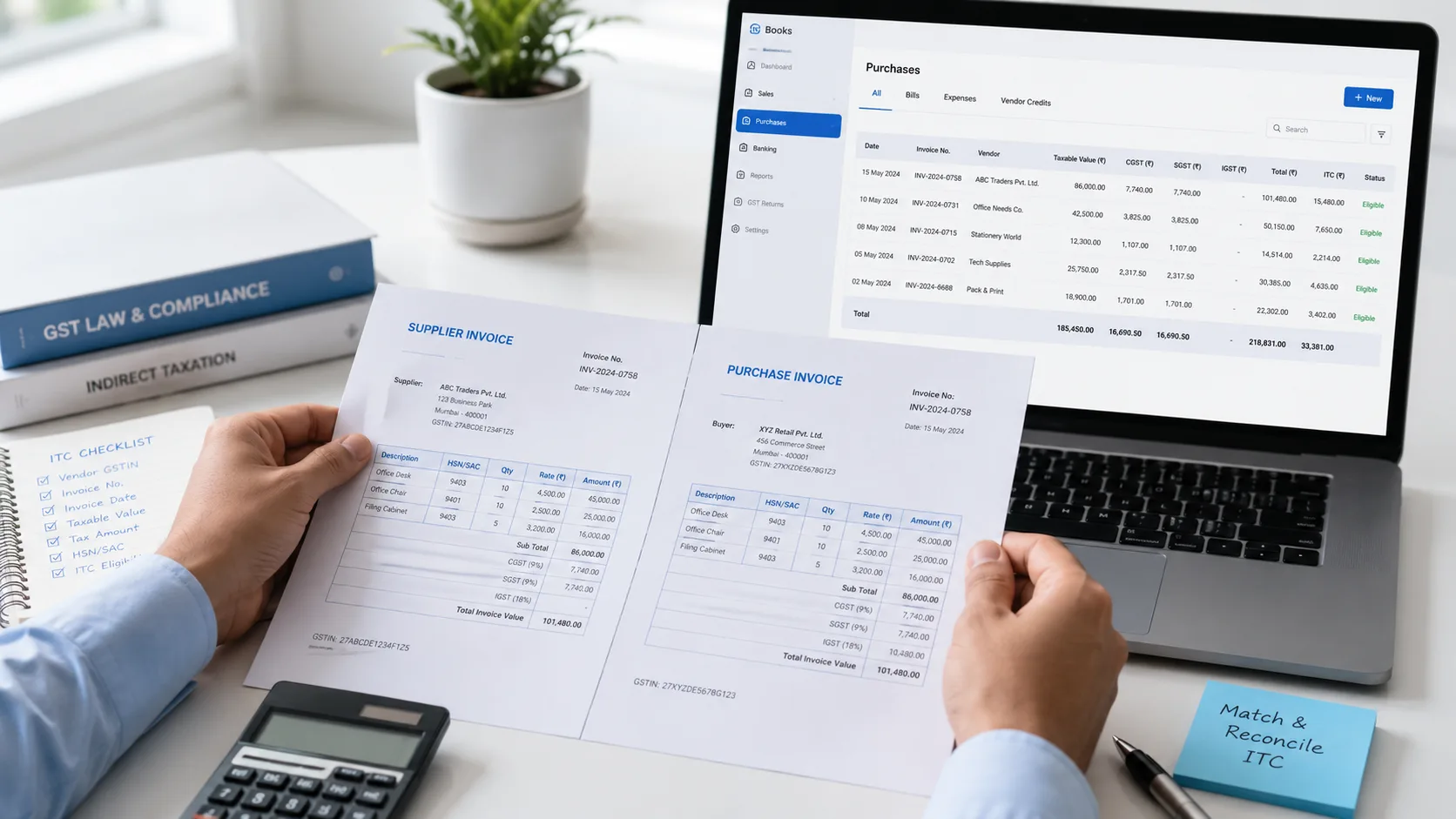
- Reconcile GSTR-2B monthly: don't wait until the annual return. Match your purchase register against 2B every month and flag missing invoices immediately.
- Vet your suppliers: check their GST return filing status on the portal before onboarding new vendors. A non-compliant supplier costs you more than just late deliveries.
- Pay within 180 days: set up a system to track invoice ageing specifically against the 180-day reversal deadline.
The four conditions for claiming ITC
| Condition | What it means |
|---|---|
| Valid tax invoice | Proper GST invoice with both GSTINs and tax split |
| Goods/services received | Credit triggers on delivery, not invoicing |
| Supplier paid the tax | Invoice reflects in your GSTR-2B |
| Return filed | Claimed through your own GSTR-3B |
Frequently asked questions
Can I claim ITC if the invoice isn't in my GSTR-2B?
No. Since 2022, ITC is restricted to what appears in your GSTR-2B, even if you hold the physical invoice. Your supplier's compliance becomes your concern.
What happens if I don't pay my supplier within 180 days?
You must reverse the ITC plus interest. Pay the supplier and you can reclaim it.
Is ITC available on a company car?
Generally no, under section 17(5), unless you are in passenger transport, vehicle sales or driver training.
ITC is your money, you just need the right process to keep it. FilingSetu's GST compliance service includes monthly 2B reconciliation as standard, so you never lose a credit to a paperwork gap.