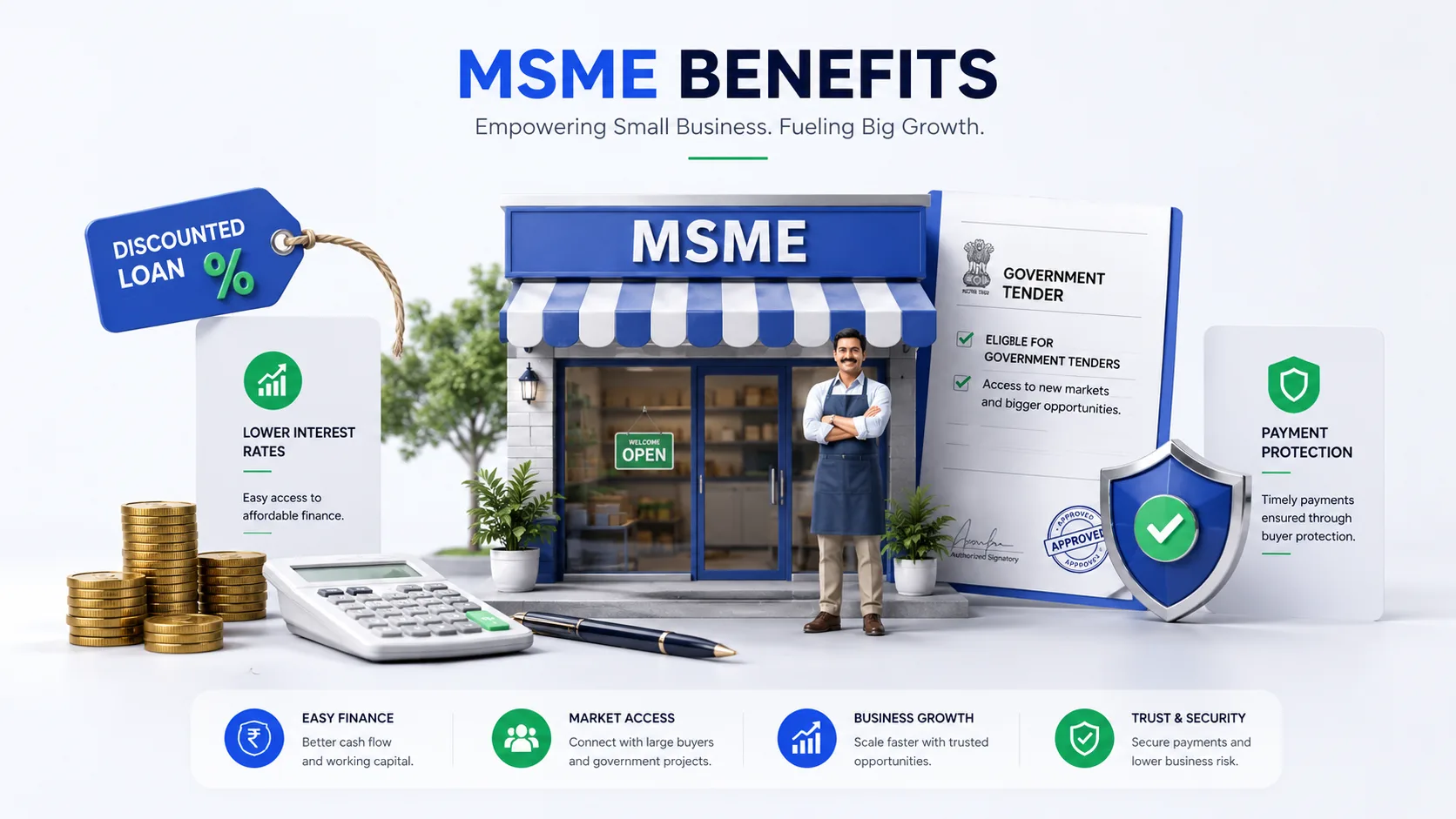
Udyam (MSME) registration has these main benefits. Banks treat your loan as a priority sector loan. Micro and small businesses get loans up to ₹10 lakh without collateral. Buyers must pay micro and small suppliers within 45 days or pay interest. Government buyers give tender benefits. Trademark filing costs less. Registration itself is free.
- Several benefits are only for micro and small enterprises. Medium enterprises get fewer.
- The late-payment protection covers micro and small suppliers only (MSMED Act, section 2(n)).
- Retail and wholesale traders get only the bank lending benefit.
- Each benefit needs your Udyam Registration Number as proof.
The benefits at a glance
| Benefit | Who gets it | Source |
|---|---|---|
| Priority sector lending from banks | Micro, small and medium; traders too | RBI MSME FAQ, Q1; RBI circular 7 July 2021 |
| No collateral on loans up to ₹10 lakh | Micro and small | RBI MSME FAQ, Q11 |
| Credit guarantee (CGTMSE) cover up to ₹10 crore | Micro and small | RBI MSME FAQ, Q12 |
| Payment within 45 days, or interest | Micro and small suppliers | MSMED Act, sections 15 and 16 |
| Government purchase benefits: free tender sets, no EMD, L1 + 15% | Micro and small (not traders) | DC-MSME FAQ on Public Procurement Policy |
| Lower trademark filing fee | Small enterprise rate | Trade Marks Rules, 2017, First Schedule |
1. Easier bank loans
Banks use the category on your Udyam certificate to decide whether your loan is an MSME loan under priority sector lending (RBI MSME FAQ, Q1).
For micro and small enterprises, banks must not ask for collateral on loans up to ₹10 lakh (RBI MSME FAQ, Q11).
The Credit Guarantee Fund Trust for Micro and Small Enterprises (CGTMSE) can cover collateral-free credit up to ₹10 crore. The lender pays a guarantee fee (RBI MSME FAQ, Q12).
2. Protection from late payment
If you are a micro or small supplier with a Udyam registration, the MSMED Act protects you:
- The buyer must pay on the date agreed in writing. The agreed period cannot be more than 45 days from acceptance of the goods or services (section 15).
- If there is no written agreement, the buyer must pay within 15 days of acceptance (section 15).
- If the buyer pays late, the buyer owes compound interest with monthly rests at three times the bank rate notified by RBI (section 16).
- Either side can take the dispute to the Micro and Small Enterprises Facilitation Council (section 18).
- A buyer whose accounts are audited must show unpaid MSME dues in its annual accounts (section 22).
- The buyer cannot claim this interest as a deduction for income tax (section 23).
Buyers that pay late also lose the tax deduction until they pay (section 43B(h) of the Income-tax Act, 1961; section 37(2)(g) of the Income-tax Act, 2025 from tax year 2026-27). Full guide: MSME 45 days payment rule.
Who is not covered. Section 2(n) defines a "supplier" as a micro or small enterprise that has filed its memorandum. Medium enterprises are not covered. Our reading is that traders are not covered either (RBI circular, 7 July 2021: traders are MSMEs only for priority sector lending).
As of 9 October 2026: the MSMED (Amendment) Bill, 2026, passed by Parliament in August 2026, adds faster mediation and arbitration steps and settlement through TReDS for central public sector buyers. These start only on dates the government notifies. We found no change to the 45-day limit in the PRS summary of the Bill.
3. Government tenders
Under the Public Procurement Policy for Micro and Small Enterprises:
- Central ministries, departments and central public sector enterprises must buy at least 25% of their yearly purchases from micro and small enterprises. Within that, 4% is for MSEs owned by SC/ST entrepreneurs and 3% for MSEs owned by women.
- MSEs get tender sets free of cost and are exempt from earnest money deposit (EMD).
- An MSE that quotes within L1 + 15% can also be allowed to supply when the lowest bid is from a non-MSE.
- There is no exemption from security deposit or performance bank guarantee.
- The benefit applies only for the item group (NIC code) you registered on Udyam.
- Traders, distributors, sole agents and works contracts are excluded.
Source: DC-MSME, FAQs on the Public Procurement Policy (Q1, Q2, Q8, Q11, Q18, Q20, Q29, Q49).
For an EMD exemption, show your Udyam certificate with the bid, and check that the item you bid for is under an NIC code on your registration (DC-MSME FAQ, Q29).
4. Lower trademark filing fee
The Trade Marks Registry charges a lower fee to an individual, a startup or a small enterprise. For e-filing a new trademark application (Form TM-A), the fee is ₹4,500 per class instead of ₹9,000 (₹5,000 instead of ₹10,000 on paper). Source: IP India, Forms and official fees. The Registry asks a small enterprise for its Udyam number as proof.
Need a trademark? See our trademark registration service.
5. Tax benefits
There is no separate income tax exemption for being an MSME that we could confirm. The tax link is the buyer-side rule in section 43B(h) (section 2 above): it pushes your buyers to pay on time.
Disadvantages of MSME registration
This section is our reading of the rules above.
- No benefit for some businesses. Medium enterprises get no late-payment protection. Traders get only the bank lending benefit.
- Buyers may push back. Because late payment hurts the buyer's tax deduction under section 43B(h), some buyers may ask suppliers whether they are registered before placing orders.
- You must give true details. Registration is on self-declaration. False details, or hiding facts, can be penalised under section 27 of the MSMED Act (Udyam portal).
- Benefits are not automatic. You claim each one: you show the certificate to the bank, attach it to the tender, or file the claim before the Facilitation Council.
How to claim MSME benefits
| Benefit | How you claim it |
|---|---|
| Bank loan | Give your Udyam Registration Number or certificate to the bank |
| Late payment interest | Ask the buyer first. If unpaid, refer the dispute to the Micro and Small Enterprises Facilitation Council (section 18) |
| Tender benefits | Upload the Udyam certificate with the bid, for the registered NIC code |
| Trademark fee | Choose the small enterprise category and give your Udyam number |
To register first, read our Udyam registration guide.
Not registered yet? See our MSME registration service.
Frequently asked questions
What are the benefits of MSME registration?
Priority sector lending, no collateral on loans up to ₹10 lakh for micro and small enterprises, payment within 45 days or interest, government tender benefits and a lower trademark fee.
Is Udyam registration free of cost?
Yes. There is no fee for filing Udyam registration on the government portal.
What are the disadvantages of MSME registration?
Medium enterprises and traders get fewer benefits, you must give true details, and each benefit has to be claimed. See the section above.
How to claim MSME benefits?
Show your Udyam number or certificate to the bank, the tendering office or the Trade Marks Registry. For unpaid dues, ask the buyer, then go to the Facilitation Council.
Do MSME benefits apply to service businesses?
Yes. Service enterprises are classified under the same limits as manufacturing ones.
Do medium enterprises get the 45-day payment protection?
No. The MSMED Act covers only micro and small suppliers (section 2(n)).
Do traders get MSME benefits?
Only priority sector lending from banks. They are excluded from the Public Procurement Policy benefits.
Is EMD exempt for MSME in government tenders?
Yes, for micro and small enterprises registered on Udyam, for the NIC codes on their registration. There is no exemption from security deposit or performance guarantee.
Is there a collateral-free loan for MSME?
Banks must not take collateral on loans up to ₹10 lakh to micro and small enterprises. CGTMSE can cover collateral-free credit up to ₹10 crore.
Does MSME registration reduce trademark fees?
Yes, for the small enterprise category: ₹4,500 instead of ₹9,000 per class for e-filing.
Where do I complain about late payment?
To the Micro and Small Enterprises Facilitation Council (section 18, MSMED Act).
Hinglish mein sawaal
Udyam registration se kya fayda hota hai?
Bank loan aasaan hota hai, ₹10 lakh tak bina collateral loan, buyer ko 45 din mein payment karna hota hai, sarkari tender mein EMD nahi lagta aur trademark fees kam lagti hai.
Kya MSME registration ke nuksan bhi hain?
Seedha nuksan nahi hai. Medium enterprise aur traders ko kam fayde milte hain, aur galat details dene par penalty lag sakti hai.
Last reviewed: 10 October 2026
FilingSetu is the brand of ANR Consultancy, a partnership firm.
GSTIN: 07ACOFA0324K1ZG
This page explains the law as it stands on the review date. It is not advice on your specific case.