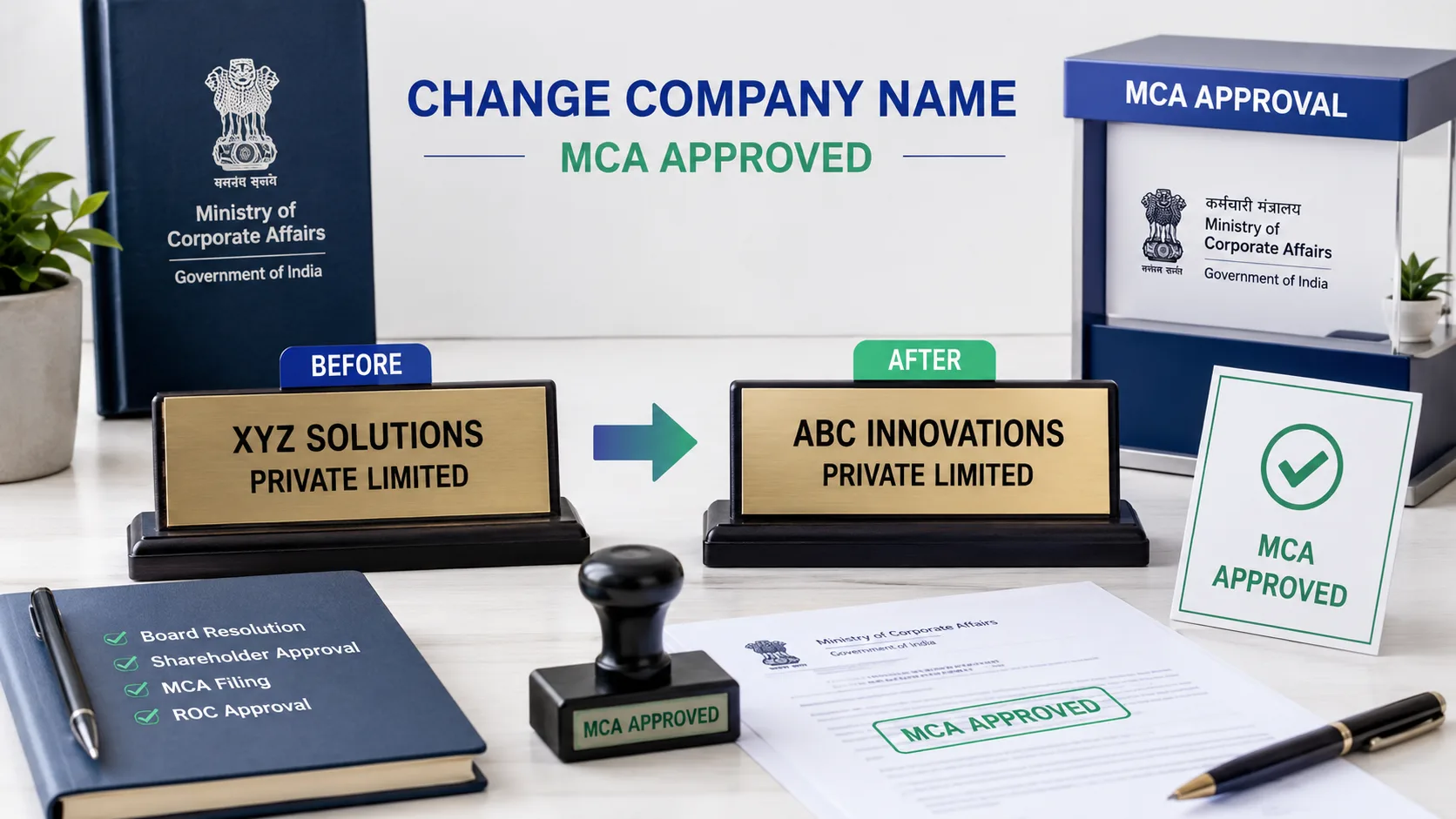
A company's name can be changed by a special resolution of its shareholders and the written approval of the Central Government, under section 13 of the Companies Act, 2013. You reserve the new name, pass the resolution, file MGT-14 within 30 days and apply in Form INC-24. The change takes effect only when the Registrar issues a fresh certificate of incorporation.
- A name change needs a special resolution and the Central Government's approval in writing (section 13).
- File MGT-14 for the special resolution within 30 days, and INC-24 for the approval.
- The change is complete only when the Registrar issues a fresh certificate of incorporation with the new name.
- Afterwards, update PAN, TAN, GST, bank accounts and every registration in the company's name.
The steps
- Check the new name. Under section 4(2), it cannot be identical with or too nearly resemble an existing company's name, and its use cannot be an offence or undesirable in the Central Government's view.
- Board meeting. The board approves the proposal and calls a general meeting.
- Reserve the name. Apply through the MCA's RUN (Reserve Unique Name) web service. The government fee is ₹1,000 per application.
- Special resolution. Shareholders pass a special resolution to change the name (section 13(1)).
- File MGT-14 with the special resolution within 30 days of passing it (section 117).
- File INC-24 to apply for the Central Government's approval, with the fee (rule 29).
- Fresh certificate. The Registrar enters the new name and issues a fresh certificate of incorporation. The change is complete and effective only then (section 13(3)).
Only adding or dropping “Private”? If the only change is adding or deleting the word “Private” because the company converts from one class to another, no Central Government approval is needed (proviso to section 13(2)).
What to update after approval
- PAN and TAN details with the income tax department.
- GST registration: apply for an amendment. See our GST amendment guide.
- Bank accounts, signboards, invoices and letterheads.
- Licences, registrations and contracts in the company's name.
“A new name is a legal change, not just branding. The company stays the same; the paperwork has to catch up.”
Frequently asked questions
Can a Pvt Ltd company name be changed?
Yes. A private limited company can change its name by a special resolution and the Central Government's written approval, applied for in Form INC-24.
The name of a company can be changed by?
A special resolution of the shareholders, with the approval of the Central Government in writing (section 13 of the Companies Act, 2013).
What is Form INC-24?
The MCA e-form to apply for the Central Government's approval for a change of name (rule 29 of the Companies (Incorporation) Rules, 2014). It is filed with the fee for a change of name.
What documents are required to change a company name?
The special resolution (filed in MGT-14) and the INC-24 application. The e-form lists its own attachments when you fill it.
How much does it cost to change a company name?
The government fee for reserving a name through RUN is ₹1,000 per application. INC-24 and MGT-14 carry their own filing fees under the MCA fee rules. For our help, see our company name change service.
How long does a company name change take?
It depends on the MCA's processing. The change takes effect only on the date the Registrar issues the fresh certificate.
Can I be refused a new name?
Yes. A name is refused if it is identical with or too nearly resembles an existing company's name, or if its use would be an offence or is undesirable in the Central Government's view (section 4(2)).
Does changing the name change my company's identity?
No. Our reading of section 13 is that the company continues: the Registrar replaces the old name with the new one in the register. Assets, liabilities and contracts stay with the company.
Is approval needed if we only add or remove “Private”?
No. If the only change is adding or deleting “Private” because the company converts to another class, no Central Government approval is needed.
Which forms are filed for a name change?
RUN to reserve the name, MGT-14 for the special resolution and INC-24 for the approval.
What do I update after the name change?
PAN and TAN, GST registration (through an amendment), bank accounts, licences, contracts, invoices and letterheads.
Hinglish mein sawaal
Company ka naam kaise badle?
Naya naam RUN se reserve karein, shareholders ka special resolution pass karein, 30 din mein MGT-14 aur phir INC-24 file karein. Naya certificate milne par naam badal jaata hai.
Naam badalne ke liye kaun se forms bharne padte hain?
RUN (naam reserve), MGT-14 (special resolution) aur INC-24 (Central Government ki approval).
Last reviewed: 9 October 2026
FilingSetu is the brand of ANR Consultancy, a partnership firm.
GSTIN: 07ACOFA0324K1ZG
This page explains the law as it stands on the review date. It is not advice on your specific case.
Our company name change service handles the resolutions, filings and downstream updates. Explore all company and ROC services.