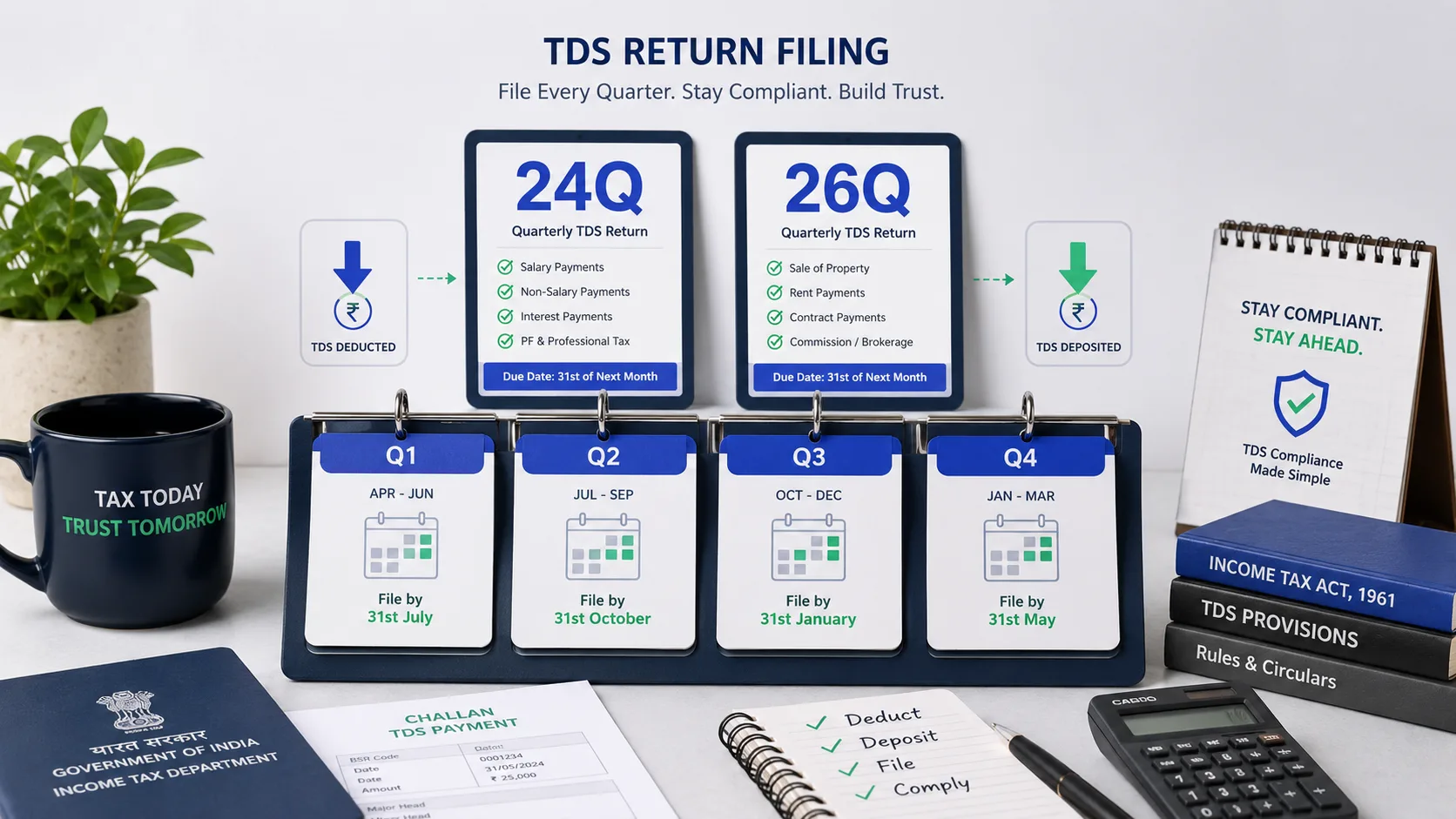
A TDS return is a quarterly statement that a person who deducts tax at source (the deductor) files with the Income Tax Department. It lists each payment, the tax deducted and the challan used to pay it. Returns are due on 31 July, 31 October, 31 January and 31 May. From tax year 2026-27, Form 24Q is Form 138 and Form 26Q is Form 140.
This guide covers which form to use, every due date for filing and for paying TDS, how to file, the certificates you must give, and what happens if you are late.
- Four returns a year: 31 July (April to June), 31 October (July to September), 31 January (October to December), 31 May (January to March).
- Pay the TDS by the 7th of the next month. TDS deducted in March is due by 30 April.
- New form numbers apply from 1 April 2026: 138 (salary), 140 (other payments to residents), 144 (non-residents), 143 (TCS).
- Late fee: ₹200 a day until you file, but not more than the TDS. A penalty of ₹10,000 to ₹1,00,000 can also apply.
- Late payment of TDS costs 1.5% interest a month. Not deducting at all costs 1% a month.
Which TDS return form to use
The form depends on whom you paid and under which law the payment falls. Payments made up to 31 March 2026 fall under the Income-tax Act, 1961. Payments from 1 April 2026 (tax year 2026-27) fall under the Income-tax Act, 2025.
| What you report | Up to March 2026 (1961 Act) | From tax year 2026-27 (2025 Act) |
|---|---|---|
| TDS on salary | Form 24Q | Form 138 |
| TDS on other payments to residents (rent by businesses, contractors, professional fees, commission, interest) | Form 26Q | Form 140 |
| TDS on payments to non-residents | Form 27Q | Form 144 |
| TCS (tax collected at source) | Form 27EQ | Form 143 |
| Rent or property bought by an individual or HUF without a TAN | Form 26QC or 26QB (one per payment) | Form 141 (one per payment) |
TDS return due dates
The due dates are the same for every deductor and the same under both laws.
| Quarter | Months | Due date, FY 2025-26 | Due date, tax year 2026-27 |
|---|---|---|---|
| Q1 | April to June | 31 July 2025 | 31 July 2026 |
| Q2 | July to September | 31 October 2025 | 31 October 2026 |
| Q3 | October to December | 31 January 2026 | 31 January 2027 |
| Q4 | January to March | 31 May 2026 | 31 May 2027 |
Form 141 is different. It is filed for each payment, within 30 days from the end of the month in which you deducted the tax.
TDS payment due dates
Filing the return and paying the tax are two separate deadlines. You pay first, then report the payment in the return.
| TDS deducted in | Pay by |
|---|---|
| April to February | 7th of the next month (for example, TDS deducted in October 2026 is due by 7 November 2026) |
| March | 30 April |
| Rent, property or other Form 141 payments | Within 30 days from the end of the month of deduction, with Form 141 |
| Government office paying without a challan | The same day |
The Assessing Officer can allow quarterly payment in special cases, with prior approval of the Joint Commissioner (7 July, 7 October, 7 January and 30 April). You need that permission first.
Who must file a TDS return
Every person who deducted TDS during the quarter files a return for it, through the TAN (tax deduction account number) used to deduct. This covers employers, companies, firms, and individuals or HUFs that deduct tax on their payments. See our TAN vs PAN guide if you do not have a TAN yet.
Two cases do not file a quarterly return:
- An individual or HUF paying rent above ₹50,000 a month without a TAN. They pay and report each deduction in Form 141 instead. See TDS on rent.
- An individual or HUF buying property. They also use Form 141 (old Form 26QB). The rules are in our capital gains on property guide.
How to file a TDS return
- Pay all TDS for the quarter with the right challan, and keep the challan details (BSR code, date, challan serial number).
- Collect deductee details: PAN, amount paid, date, section and TDS for each payment.
- Prepare the return in the department's file format. Use the free Return Preparation Utility (RPU) from Protean, the department's TIN service provider, or your own TDS software.
- Validate the file with Protean's File Validation Utility (FVU). If it shows errors, fix them and run it again. A clean run creates a .fvu file.
- Submit the .fvu file. Upload it on the income tax e-filing portal (your organisation must be registered there), or hand it in at a TIN Facilitation Centre (TIN-FC).
- Check that it was accepted, then download the TDS certificates from TRACES and give them to the deductees.
TIN-FC charges (Protean, 11 October 2026, before GST): up to 100 deductee records ₹50; 101 to 1,000 records ₹213.60; more than 1,000 records ₹694.20. Uploading on the e-filing portal yourself has no such charge listed.
Want this done for you? See our TDS return filing service.
TDS certificates you must give
After the return, you give each deductee a certificate. Certificates count only if they are generated from TRACES.
| Certificate | Was | For | Give by |
|---|---|---|---|
| Form 130 | Form 16 | Salary | 15 June after the tax year |
| Form 131 | Form 16A | Other payments in the quarterly return | 15 days from the return's due date |
| Form 132 | Forms 16B, 16C, 16D, 16E | Payments reported in Form 141 (rent, property) | 15 days from the Form 141 due date |
| Form 133 | Form 27D | TCS | 15 days from the TCS return's due date |
Late fee, penalty and interest
| What went wrong | Tax year 2026-27 (2025 Act) | FY 2025-26 and earlier (1961 Act) | Amount |
|---|---|---|---|
| Return filed late | Section 427 | Section 234E | ₹200 for every day of delay, up to the TDS amount. Pay it before you file |
| Return not filed, or wrong details | Section 461 | Section 271H | Penalty of ₹10,000 to ₹1,00,000 |
| TDS not deducted | Section 398(3) | Section 201(1A) | 1% a month or part of a month, from the date it was deductible to the date it was deducted |
| TDS deducted but paid late | Section 398(3) | Section 201(1A) | 1.5% a month or part of a month, from the date of deduction to the date of payment |
| TDS not deducted or not paid in the year, on a payment to a resident | Section 35(b) | Section 40(a)(ia) | 30% of that expense is not allowed in that year; it is allowed in the year the TDS is paid |
No penalty if you file within one month. Section 461 (and 271H from AY 2025-26) lets you avoid the penalty if you paid the TDS, the late fee and the interest, and filed the return within one month of the due date. The late fee still applies.
Example. Q2 of tax year 2026-27 is due on 31 October 2026. You file on 20 November 2026 with ₹30,000 TDS in the return. The delay is 20 days, so the fee is 20 × ₹200 = ₹4,000. It is less than ₹30,000, so the full ₹4,000 is due before you file.
If you made a mistake in a filed return
You fix it with a correction statement, not a new return. You get two years from the end of the tax year in which the return was due. The steps, the correction types and a table of last dates are in our TDS correction return guide.
Frequently asked questions
What is the last date for filing a TDS return?
31 July for April to June, 31 October for July to September, 31 January for October to December and 31 May for January to March. For tax year 2026-27 the dates are 31 July 2026, 31 October 2026, 31 January 2027 and 31 May 2027.
What is 24Q and 26Q in TDS?
Form 24Q is the quarterly return for TDS on salary. Form 26Q is the quarterly return for TDS on other payments to residents, such as rent, contractor payments and professional fees. From tax year 2026-27 they are Form 138 and Form 140.
What is 24Q and 26Q due date?
Both have the same dates: 31 July, 31 October, 31 January and 31 May. Forms 138 and 140 keep these dates.
Is the TDS return filing date extended?
Extensions come only through a CBDT order. Check the department's site before you rely on a later date.
What is the last date for TDS payment in 2026?
TDS deducted in a month is due by the 7th of the next month. TDS deducted in March 2026 was due by 30 April 2026. Rent and property TDS paid through Form 141 is due within 30 days from the end of the month of deduction.
How to do TDS return filing?
Pay the TDS, prepare the return in the RPU or your software, validate it with the FVU, and upload the .fvu file on the e-filing portal or at a TIN-FC. Then download the certificates from TRACES.
Can I file a TDS return myself?
Yes. The RPU and FVU are free, and you can upload on the e-filing portal once your organisation is registered there. You need correct PAN and challan details for every deductee.
How much penalty for TDS return?
A late return costs ₹200 a day, up to the TDS amount. Not filing, or filing wrong details, can bring a penalty of ₹10,000 to ₹1,00,000. The penalty does not apply if you paid everything and filed within one month of the due date.
What is the late fee under section 234E?
₹200 for every day the return is late, but not more than the TDS in that return. From tax year 2026-27 the same fee is in section 427 of the Income-tax Act, 2025.
What is the interest on late payment of TDS?
1.5% a month or part of a month, from the date you deducted the tax to the date you paid it. If you did not deduct at all, it is 1% a month from the date it should have been deducted.
Do I need a TAN to file a TDS return?
Yes, the quarterly returns are filed under your TAN. Only an individual or HUF using Form 141 for rent or property can use a PAN instead.
What is Form 27Q and 27EQ?
Form 27Q is the quarterly return for TDS on payments to non-residents. Form 27EQ is the quarterly return for TCS. From tax year 2026-27 they are Form 144 and Form 143.
What is RPU and FVU?
RPU is the Return Preparation Utility and FVU is the File Validation Utility. Both are free tools from Protean. The RPU builds the return file and the FVU checks it before you upload.
Hinglish mein sawaal
TDS return kab tak file karna hota hai?
Har quarter ke baad: 31 July, 31 October, 31 January aur 31 May. 2026-27 se Form 24Q ka naam Form 138 aur 26Q ka naam Form 140 hai.
TDS return late hone par kitni late fee lagti hai?
₹200 per day, lekin TDS amount se zyada nahi. Fee return file karne se pehle bharni hoti hai.