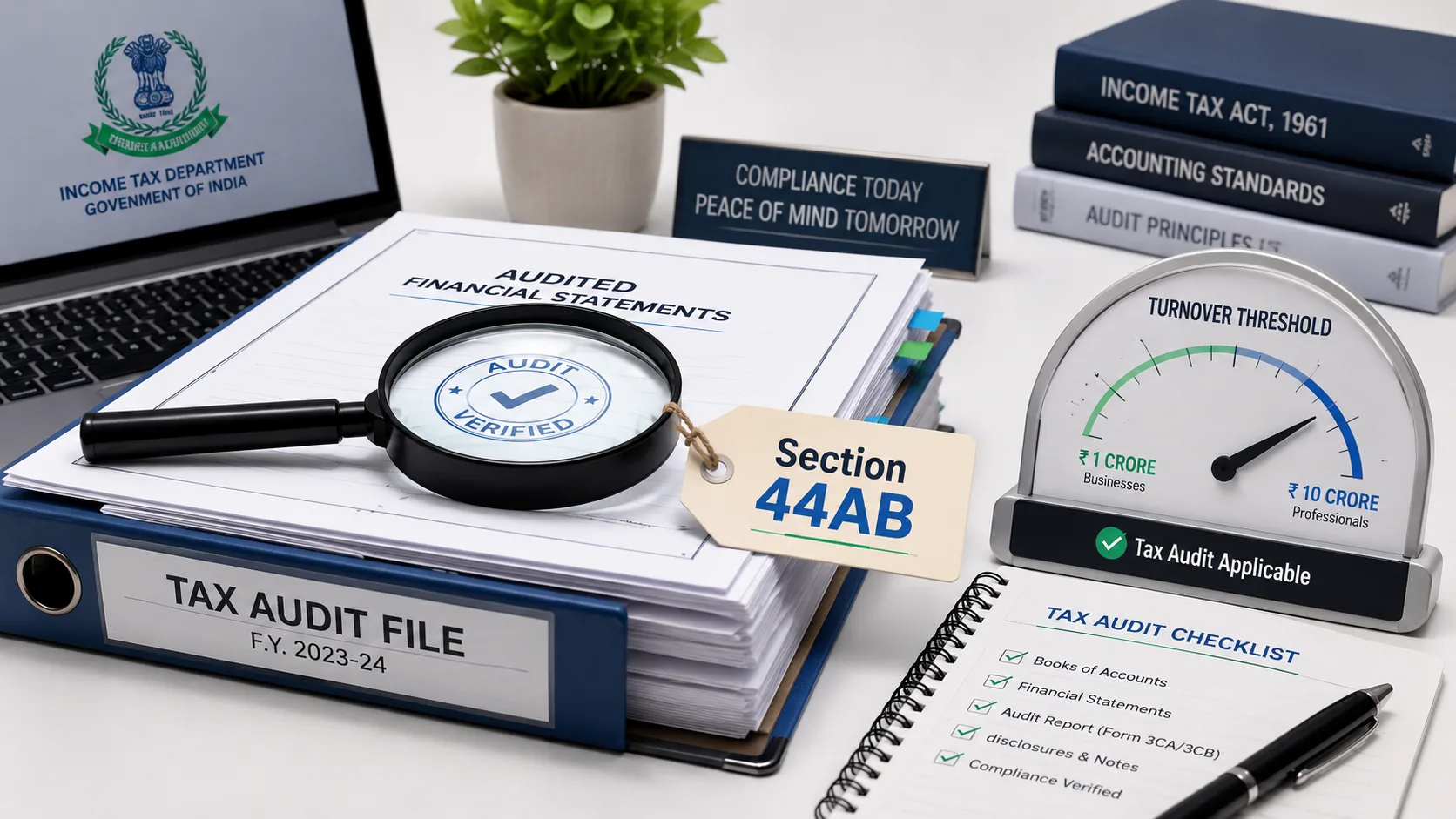
A tax audit under section 44AB is compulsory for FY 2025-26 (AY 2026-27) if your business turnover is more than ₹1 crore, or ₹10 crore if your cash receipts and cash payments are each 5% or less of the total. For a profession, the limit is ₹50 lakh of gross receipts. For AY 2026-27, CBDT has extended the audit report date to 21 October 2026 and the return date to 21 November 2026.
What is a tax audit under section 44AB?
A tax audit is a check of your books of account by a chartered accountant, for income tax purposes. Section 44AB of the Income-tax Act, 1961 says who must get one. The CA gives an audit report in Form 3CA or Form 3CB, along with a statement of particulars in Form 3CD, and files them on the income tax e-filing portal.
Only a chartered accountant can do a tax audit. The Act calls this person an "accountant", which means a chartered accountant.
Tax audit limit for AY 2026-27: who needs a tax audit
Section 44AB has five cases. You need a tax audit if any one of them fits you.
| Clause | Who | When a tax audit is needed |
|---|---|---|
| 44AB(a) | Business | Total sales, turnover or gross receipts are more than ₹1 crore. The limit is ₹10 crore if cash receipts and cash payments are each 5% or less (see the next section) |
| 44AB(b) | Profession | Gross receipts are more than ₹50 lakh |
| 44AB(c) | Business under section 44AE, 44BB or 44BBB | You claim profit lower than the profit those sections fix |
| 44AB(d) | Profession under section 44ADA | You claim profit lower than 50% of receipts, and your income is above the basic exemption limit |
| 44AB(e) | Business where section 44AD(4) applies | You left the 44AD scheme within five years of using it, and your income is above the basic exemption limit |
One rule sits above the table: section 44AB does not apply to you if you declare your profit under section 44AD(1) or 44ADA(1). That is the presumptive scheme, explained below.
The same section 44AB limits applied for AY 2024-25 and AY 2025-26. So if you are checking an older year, the ₹1 crore, ₹10 crore and ₹50 lakh figures are the same.
Section 44AB applies to every person carrying on a business or profession: individuals, HUFs, partnership firms, LLPs and companies. What changes is the form the CA uses (see Forms 3CA, 3CB and 3CD below).
The 5% cash test for the ₹10 crore limit
The ₹10 crore limit applies only if both of these are true for the year:
- Cash received (including cash received for sales, turnover or gross receipts) is 5% or less of all amounts received.
- Cash paid (including cash paid for expenses) is 5% or less of all payments made.
A payment or receipt by a cheque or bank draft that is not account payee counts as cash for this test.
If either figure is above 5%, your limit stays at ₹1 crore.
The ₹10 crore limit is for a business only. For a profession, the limit is ₹50 lakh with no cash test in section 44AB.
If you trade shares, intraday or F&O, how your "turnover" is worked out for this test is set out in the Institute of Chartered Accountants of India (ICAI) Guidance Note on Tax Audit, not in section 44AB. Our guide to F&O and intraday trading tax explains the ICAI method with an example, and our ITR-3 guide shows where trading income goes in the return.
Tax audit and presumptive tax (44AD and 44ADA)
Section 44AB and sections 44AD and 44ADA are different rules. One decides who needs an audit; the other two let small businesses and professionals declare a fixed share of receipts as profit.
| Section 44AB | Section 44AD | Section 44ADA | |
|---|---|---|---|
| What it is | Tax audit | Presumptive tax for business | Presumptive tax for professionals |
| Who | Anyone carrying on business or profession | Resident individual, HUF or partnership firm (not an LLP), in an eligible business | Resident individual or partnership firm (not an LLP), in a profession listed in section 44AA(1) |
| Limit | ₹1 crore (₹10 crore with the 5% cash test) for business; ₹50 lakh for profession | Turnover up to ₹2 crore, or ₹3 crore if cash received is 5% or less | Gross receipts up to ₹50 lakh, or ₹75 lakh if cash received is 5% or less |
| Profit declared | Not a profit rule. It decides who needs an audit | At least 8% of turnover, or 6% on amounts received by account payee cheque or draft, ECS or other prescribed electronic mode | At least 50% of gross receipts |
Two things follow from the law:
- If you declare profit under 44AD or 44ADA, section 44AB does not apply. So a resident trader with ₹2.5 crore turnover and 3% cash receipts who declares income under 44AD does not need a tax audit, even though the turnover is above ₹1 crore.
- If you are eligible for presumptive tax but declare lower profit, an audit can apply. A professional under 44ADA who claims less than 50% of receipts as profit, with income above the basic exemption limit, needs an audit under 44AB(d). A business that used 44AD and then leaves it within five years, with income above the basic exemption limit, needs an audit under 44AB(e).
Note the cash tests are not the same. The ₹3 crore (44AD) and ₹75 lakh (44ADA) limits look only at cash received. The ₹10 crore tax audit limit looks at cash received and cash paid.
The department's own FAQ on who needs a tax audit still mentions a ₹2 crore limit for 44AD. The current section 44AD says ₹3 crore where cash received is 5% or less. We follow the section text. For more on the scheme, read our guide to presumptive taxation under 44AD and 44ADA.
Do you need a tax audit? Five examples
All examples are for FY 2025-26 (AY 2026-27) and assume the person is not declaring income under 44AD or 44ADA unless stated.
| Case | Figures | Tax audit? | Why |
|---|---|---|---|
| Wholesale trader | Turnover ₹6 crore; cash received 3%, cash paid 2% | No | Both cash figures are 5% or less, so the limit is ₹10 crore |
| Retail shop | Turnover ₹6 crore; cash received 12% | Yes | Cash received is above 5%, so the limit is ₹1 crore |
| Doctor | Gross receipts ₹60 lakh; accounts on actual profit | Yes | Above ₹50 lakh under 44AB(b) |
| Resident professional in a profession listed in section 44AA(1) | Gross receipts ₹70 lakh; cash received 2%; declares 50% under 44ADA | No | Within the ₹75 lakh 44ADA limit and declaring under 44ADA(1), so 44AB does not apply |
| Another professional of the same kind | Gross receipts ₹30 lakh; eligible for 44ADA but claims profit of ₹10 lakh (less than 50%); income above the basic exemption limit | Yes | Audit under 44AB(d) |
Tax audit due date for AY 2026-27
The law gives the tax audit report a "specified date": one month before the due date of your income tax return.
| Case | Tax audit report due | Income tax return due |
|---|---|---|
| Accounts need a tax audit (extended by CBDT) | 21 October 2026 | 21 November 2026 |
| You must also file a transfer pricing report under section 92E (not extended) | 31 October 2026 | 30 November 2026 |
Under the law, the audit report is due one month before the return: 30 September and 31 October for audit cases. For AY 2026-27, CBDT moved both dates by 21 days (see below). Your CA files the report on the portal and you then accept it there, so leave time for both steps before the date.
An individual or HUF with a tax audit files ITR-3. It asks "Are you liable for audit under section 44AB?", and if you say yes you must fill the balance sheet and profit and loss parts. ITR-4 is for presumptive income under 44AD, 44ADA or 44AE. Firms (including LLPs) file ITR-5, and companies ITR-6. See which ITR form to file.
Tax audit due date extension: has it been extended?
Yes. On 28 September 2026, CBDT extended the AY 2026-27 dates for audit cases:
- Tax audit report: from 30 September 2026 to 21 October 2026
- Income tax return: from 31 October 2026 to 21 November 2026
The extension covers companies, anyone whose accounts must be audited under the income tax law or any other law, and partners of such firms. It does not cover cases where a transfer pricing report under section 92E is needed; for those, the dates stay at 31 October 2026 (report) and 30 November 2026 (return).
CBDT said a formal order or notification will follow. Last year it also extended the date: for AY 2025-26, from 30 September 2025 to 31 October 2025, by a press release on 25 September 2025.
Forms 3CA, 3CB and 3CD
| Form | When it is used |
|---|---|
| Form 3CA | Your accounts must already be audited under another law (for example, a company under the Companies Act). The CA gives this report with Form 3CD |
| Form 3CB | No other law requires your accounts to be audited. The CA gives this report with Form 3CD |
| Form 3CD | The statement of particulars that goes with Form 3CA or Form 3CB. It carries the detailed information the income tax law asks for |
If another law already requires your audit, you do not need a second full audit. The law accepts that audit, plus a further report by a CA in the income tax form.
How the tax audit report is filed
- You assign your CA. Log in to the e-filing portal, go to e-File > Income Tax Forms > File Income Tax Forms, pick Form 3CA-3CD or 3CB-3CD, and assign it to your CA.
- Your CA accepts and prepares it. The CA accepts the request from their Worklist and fills the form in the offline utility.
- Your CA uploads it. The CA uploads the file and submits it with their digital signature certificate (DSC).
- You accept or reject it. The form comes to your Worklist under "For your Action". Check it and accept it. If you reject it, you must give a reason.
Leave time for step 4 before the due date.
Penalty for not getting a tax audit (section 271B)
If you do not get your accounts audited, or do not furnish the audit report as section 44AB requires, the penalty under section 271B is:
0.5% of your total sales, turnover or gross receipts, or ₹1,50,000, whichever is less.
| Turnover | 0.5% of turnover | Maximum penalty |
|---|---|---|
| ₹2 crore | ₹1,00,000 | ₹1,00,000 |
| ₹5 crore | ₹2,50,000 | ₹1,50,000 (the cap) |
Section 44AB asks for the report by the specified date, so filing it late can also bring this penalty.
Under section 273B, no penalty is imposed under section 271B if you prove there was a reasonable cause for the failure. Keep a written record of any reason that stopped you from meeting the date.
What changes from tax year 2026-27
The Income-tax Act, 2025 came into force on 1 April 2026. Your accounts for FY 2025-26 (AY 2026-27) still follow section 44AB of the 1961 Act, with Forms 3CA, 3CB and 3CD.
From tax year 2026-27 (the year that started on 1 April 2026), tax audit is under section 63 of the Income-tax Act, 2025, and the report is filed in Form No. 26 instead of Forms 3CA, 3CB and 3CD.
Need help with your tax audit?
A tax audit must be done by a chartered accountant. Our tax audit service covers the audit and your income tax return for the year, from ₹4,199 + GST. We confirm a fixed fee in writing after looking at your turnover and books, before we begin.
If your accounts do not need an audit, our ITR filing plans cover business and professional returns from ₹1,149 + GST.
Frequently asked questions
What is the tax audit limit for AY 2026-27?
For a business, turnover above ₹1 crore, or above ₹10 crore if cash receipts and cash payments are each 5% or less. For a profession, gross receipts above ₹50 lakh. Presumptive and lower-profit cases are covered by clauses (c) to (e) of section 44AB.
Is the tax audit limit ₹1 crore or ₹2 crore?
The section 44AB limit for a business is ₹1 crore, or ₹10 crore with the 5% cash test. The ₹2 crore figure belongs to section 44AD, the presumptive scheme, whose limit is ₹2 crore, or ₹3 crore if cash received is 5% or less.
What is the difference between 44AB and 44AD?
Section 44AB says who must get a tax audit. Section 44AD is a presumptive scheme where an eligible small business declares 8% (or 6% on digital receipts) of turnover, or more, as profit. If you declare profit under 44AD(1), section 44AB does not apply to you.
How is the 5% cash limit worked out for a tax audit?
Add up all cash you received in the year, including for sales, and check it is 5% or less of all amounts received. Separately, add up all cash you paid, including for expenses, and check it is 5% or less of all payments. A cheque or draft that is not account payee counts as cash. Both must pass for the ₹10 crore limit.
What is the tax audit limit for professionals?
Gross receipts above ₹50 lakh. A professional who declares 50% of receipts as profit under section 44ADA (receipts up to ₹50 lakh, or ₹75 lakh if cash received is 5% or less) does not need a tax audit.
What is the tax audit due date for AY 2026-27?
21 October 2026, after CBDT extended it from 30 September 2026. The return for audit cases is now due 21 November 2026. For transfer pricing cases under section 92E, the dates were not extended: 31 October 2026 for the report and 30 November 2026 for the return.
Has the tax audit due date been extended for AY 2026-27?
Yes. On 28 September 2026, CBDT extended the tax audit report date to 21 October 2026 and the return date for audit cases to 21 November 2026. Transfer pricing cases under section 92E are not covered.
What is the difference between Form 3CA and Form 3CB?
Form 3CA is used when your accounts are already audited under another law, such as the Companies Act for a company. Form 3CB is used when no other law requires an audit. Both are filed with Form 3CD.
What is Form 3CD?
Form 3CD is the statement of particulars that the CA files along with the audit report in Form 3CA or 3CB.
What is the penalty for not getting a tax audit?
Under section 271B, 0.5% of total sales, turnover or gross receipts, or ₹1,50,000, whichever is less. No penalty is imposed if you prove reasonable cause (section 273B).
Who can do a tax audit?
Only a chartered accountant. The CA files the report on the e-filing portal after you assign the form to them, and you then accept it.
How many tax audits can a CA do?
ICAI, the body for chartered accountants, limits each CA to 60 tax audit assignments in a financial year, counted by the date the report is signed, from 1 April 2026. Some Form 3CB cases are left out of the count.
Which ITR do I file if I have a tax audit?
An individual or HUF files ITR-3, which asks whether you are liable for audit under section 44AB. Firms and LLPs file ITR-5, and companies ITR-6. ITR-4 is for presumptive income under 44AD, 44ADA or 44AE.
Hinglish mein sawaal
Tax audit kab zaroori hai?
Business mein turnover ₹1 crore se zyada ho (ya ₹10 crore, agar cash receipts aur cash payments dono 5% ya usse kam hon), ya profession mein gross receipts ₹50 lakh se zyada hon, tab tax audit zaroori hai. 44AD ya 44ADA mein income declare karne par 44AB lagu nahi hota.
Tax audit report ki last date kya hai?
AY 2026-27 ke liye ab 21 October 2026. CBDT ne 28 September 2026 ko date 30 September se badha di. Audit wale cases mein ITR ki last date ab 21 November 2026 hai.
Last reviewed: 2 October 2026
FilingSetu is the brand of ANR Consultancy, a partnership firm.
GSTIN: 07ACOFA0324K1ZG
This page explains the law as it stands on the review date. It is not advice on your specific case.