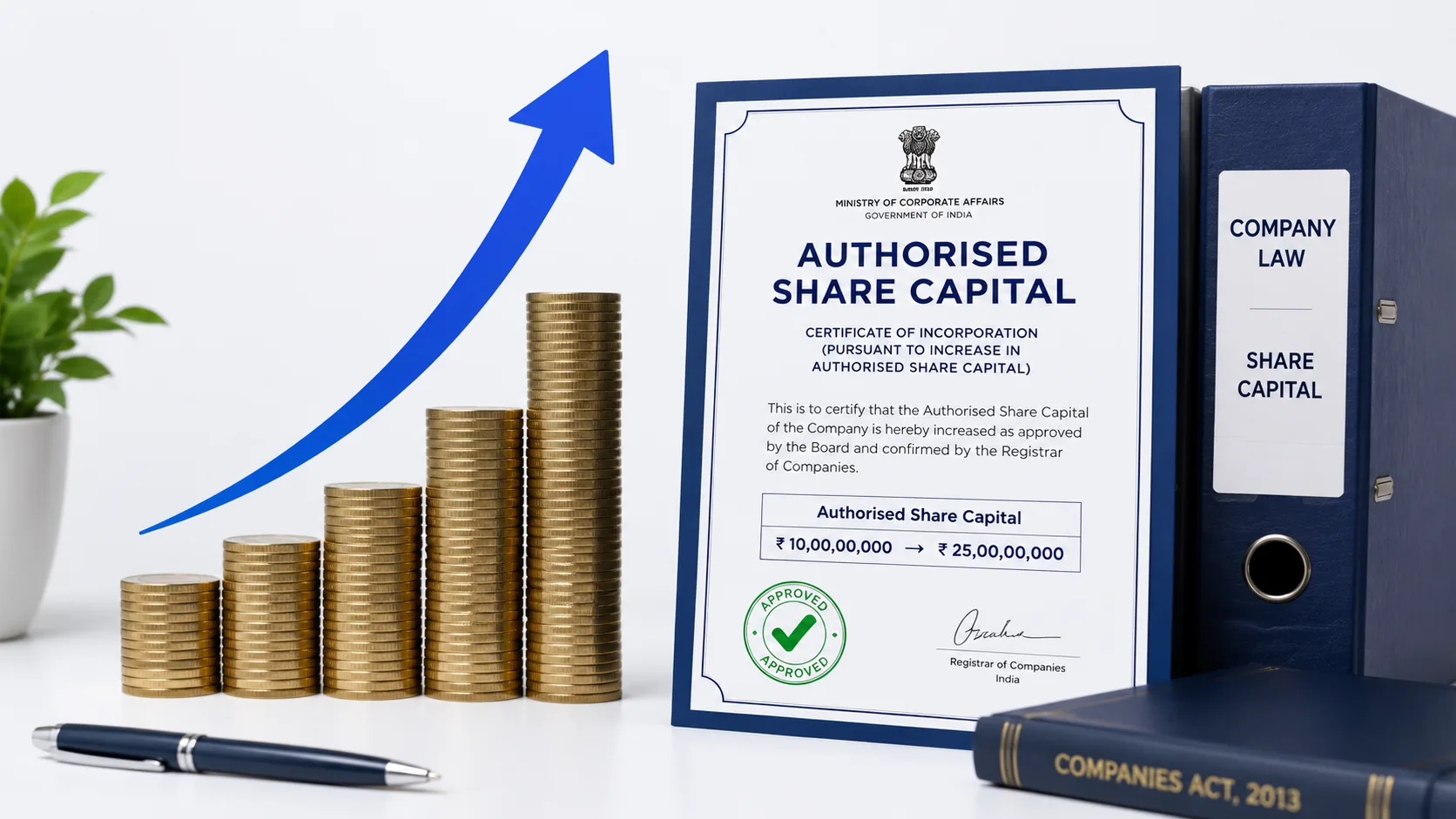
To increase authorised share capital, a company first checks that its articles allow it. The board then calls a general meeting, and the members pass an ordinary resolution under section 61 of the Companies Act, 2013. The company then files Form SH-7 with the Registrar within 30 days, with the altered memorandum, and pays the ROC fee and stamp duty.
- Authorised capital is the most share capital a company can issue. It is written in the capital clause of the memorandum.
- You must raise it before you issue shares beyond the current limit.
- Members approve the increase in a general meeting. Our reading: an ordinary resolution is enough when the articles allow the increase.
- File Form SH-7 within 30 days of the resolution.
- You pay an ROC fee on the increase and state stamp duty. Late filing costs more.
What is authorised share capital?
Authorised capital, also called nominal capital, is "such capital as is authorised by the memorandum of a company to be the maximum amount of share capital of the company" (section 2(8), Companies Act, 2013).
In simple words, it is a ceiling. A company with ₹10 lakh authorised capital cannot issue shares worth more than ₹10 lakh in total. If it wants to issue more, it must first raise the ceiling.
Authorised capital vs paid-up capital
| Authorised capital | Paid-up capital | |
|---|---|---|
| What it is | The most share capital the company may issue | The money shareholders have actually paid for shares issued |
| Where it is set | Capital clause of the memorandum | Grows when shares are allotted and paid for |
| Form to change it | SH-7 | PAS-3 (return of allotment) |
| Limit | Can be raised by the members | Can never be more than authorised capital |
Example: a company has authorised capital of ₹10 lakh and has issued shares of ₹1 lakh. Its paid-up capital is ₹1 lakh. It can still issue ₹9 lakh more without changing its authorised capital.
When do you need to increase it?
You need to increase authorised capital when a planned share issue would take the issued capital above the current limit. Common reasons are:
- bringing in new investors or a funding round,
- a rights issue to existing shareholders,
- issuing bonus shares,
- converting a loan into shares.
If the new shares fit inside the current limit, you do not need to change authorised capital. You only allot the shares and file PAS-3.
Step-by-step process
- Check the articles of association. Section 61(1) lets a company alter its capital "if so authorised by its articles". Our reading: most private companies have articles based on Table F, which allows an increase by ordinary resolution. If your articles do not allow it, the articles must be changed first by special resolution under section 14 (see MGT-14 below).
- Hold a board meeting. The board approves the proposal, fixes the date of the general meeting and approves the notice.
- Send the notice of the general meeting. The notice goes out at least 21 clear days before the meeting. A shorter notice is allowed if at least 95% of the members entitled to vote agree (section 101). Attach an explanatory statement.
- Pass the resolution in the general meeting. Members pass a resolution to increase authorised capital and to change the capital clause (clause V) of the memorandum.
- File Form SH-7 within 30 days of the resolution (section 64(1)). In the current MCA form, the altered memorandum is filed as an e-MoA inside the form.
- Pay the ROC fee and stamp duty with the form. Once the Registrar approves it, the new authorised capital shows on the company's MCA master data.
After this, the company can allot the new shares and file PAS-3 for the allotment.
Ordinary or special resolution, and is MGT-14 needed?
Section 61(1) says the company alters its capital "in its general meeting". It does not ask for a special resolution. Section 13(1), which covers other changes to the memorandum, starts with "Save as provided in section 61", so the special resolution rule for the memorandum does not apply here.
Our reading:
- If the articles already allow the increase, an ordinary resolution is enough. An ordinary resolution passes when votes for it are more than votes against (section 114(1)).
- Form MGT-14 is for special resolutions (section 117). So no MGT-14 is needed for an increase passed by ordinary resolution.
- If you first change the articles, that needs a special resolution under section 14, and that special resolution is filed in MGT-14 within 30 days.
- The SH-7 form asks whether the resolution was ordinary or special. If it was special, the form checks the approved MGT-14 for "Alteration in authorized share capital" (SH-7 instruction kit).
Form SH-7 in short
Form SH-7 is the notice to the Registrar of an alteration of share capital (section 64 and rule 15 of the Companies (Share Capital and Debentures) Rules, 2014). For an increase:
- Due date: within 30 days of the general meeting resolution.
- Signed by: a director with a digital signature.
- Certified by: a chartered accountant, company secretary or cost accountant in whole-time practice (SH-7 instruction kit).
- Filed with it: the altered memorandum (as an e-MoA in the form), and attachments such as a copy of the resolution and the notice of the meeting with the explanatory statement.
For every use of SH-7, read our SH-7 filing page.
Fees for increase in authorised capital
There are two government charges: the ROC fee and stamp duty.
1. ROC fee. The fee is the difference between the fee on the new authorised capital and the fee on the old authorised capital, at the rates in force on the filing date (Companies (Registration Offices and Fees) Rules, 2014, Table of fees, item I.3).
The MCA fee calculator gives the exact figure for your company: Enquire fees on the MCA site.
2. Stamp duty. Stamp duty is a state levy. It depends on the state of the registered office and the amount of the increase. The SH-7 form works it out from a state-wise table, and you pay it with the ROC fee on the MCA portal (SH-7 instruction kit).
FilingSetu's own fee is separate and is shown on our authorised capital increase service.
Late filing: extra fee and penalty
If SH-7 is filed after 30 days:
- Additional fee on the ROC fee: 2.5% per month for a delay of up to 6 months, and 3% per month for each month after that (Companies (Registration Offices and Fees) Rules, 2014; SH-7 instruction kit).
- Penalty under section 64(2): the company and every officer in default are liable to a penalty of ₹500 for each day the default continues, up to ₹5 lakh for the company and ₹1 lakh for each officer (Companies (Amendment) Act, 2020, in force from 21 December 2020).
Other ways to alter share capital under section 61
Alteration of share capital means changing the capital clause of the memorandum. Section 61(1) allows five changes:
- Increase authorised share capital (this guide).
- Consolidate shares into shares of a larger amount. If this changes the voting percentage of shareholders, it needs approval of the Tribunal.
- Convert fully paid-up shares into stock, or stock back into fully paid-up shares.
- Sub-divide shares into shares of a smaller amount (a share split). The paid and unpaid parts stay in the same ratio.
- Cancel shares that nobody has taken or agreed to take. This reduces the authorised capital.
Cancelling untaken shares is not a "reduction of share capital" (section 61(2)). A reduction of share capital is a different process under section 66. It needs a special resolution and confirmation by the Tribunal.
Each of these changes is reported to the Registrar in Form SH-7 within 30 days.
Frequently asked questions
What is authorised share capital?
It is the most share capital a company may issue, as written in its memorandum. The Act also calls it nominal capital (section 2(8)).
Which form is required to be filed for an increase in authorised share capital?
Form SH-7, within 30 days of the resolution, with the altered memorandum.
Is it mandatory to file MGT 14 for increase in authorized share capital?
Our reading: no, if the increase is passed by ordinary resolution under articles that allow it. MGT-14 is needed if you pass a special resolution, for example to change the articles first.
What is form SH-7 used for?
It tells the Registrar about a change in share capital: an increase, consolidation, sub-division, conversion into stock, cancellation of untaken shares, or redemption of redeemable preference shares.
What is the time limit for filing Form SH-7?
30 days from the date of the general meeting resolution (section 64(1)).
What is the fee for an increase in authorised share capital?
The ROC fee is the fee on the new capital minus the fee on the old capital, plus state stamp duty. Use the MCA fee calculator for the exact figure.
Is stamp duty payable on an increase in authorised share capital?
Yes. It is a state levy that depends on your state and the amount of the increase. It is paid with Form SH-7.
What happens when authorised capital is increased?
Nothing changes in the company's bank balance. The ceiling goes up, so the company can now issue more shares. Paid-up capital rises only when new shares are allotted.
Do I need to increase authorised capital before every allotment?
No. Only when the new shares would take issued capital above the current authorised capital.
What is the difference between authorised capital and paid-up capital?
Authorised capital is the limit. Paid-up capital is the amount shareholders have actually paid for shares issued. Paid-up capital can never be more than authorised capital.
How to increase authorised and paid-up capital?
First raise authorised capital (resolution and SH-7). Then allot the new shares and file PAS-3 for the allotment.
What if SH-7 is filed late?
You pay an additional fee of 2.5% per month on the ROC fee for up to 6 months of delay, then 3% per month. A penalty of ₹500 a day can also apply under section 64(2).
Can a private company increase authorised capital without a general meeting?
No. Section 61 needs the members' approval in a general meeting. The board alone cannot do it.
Hinglish mein sawaal
Authorised capital ka matlab kya hai?
Authorised capital woh maximum share capital hai jo company issue kar sakti hai. Yeh memorandum ke capital clause mein likha hota hai.
Authorised capital badhane ke liye kaun sa form bharna padta hai?
Form SH-7, resolution ke 30 din ke andar, altered memorandum ke saath.
Need to raise your authorised capital before a share issue? See our authorised capital increase service.
Last reviewed: 10 October 2026
FilingSetu is the brand of ANR Consultancy, a partnership firm.
GSTIN: 07ACOFA0324K1ZG
This page explains the law as it stands on the review date. It is not advice on your specific case.