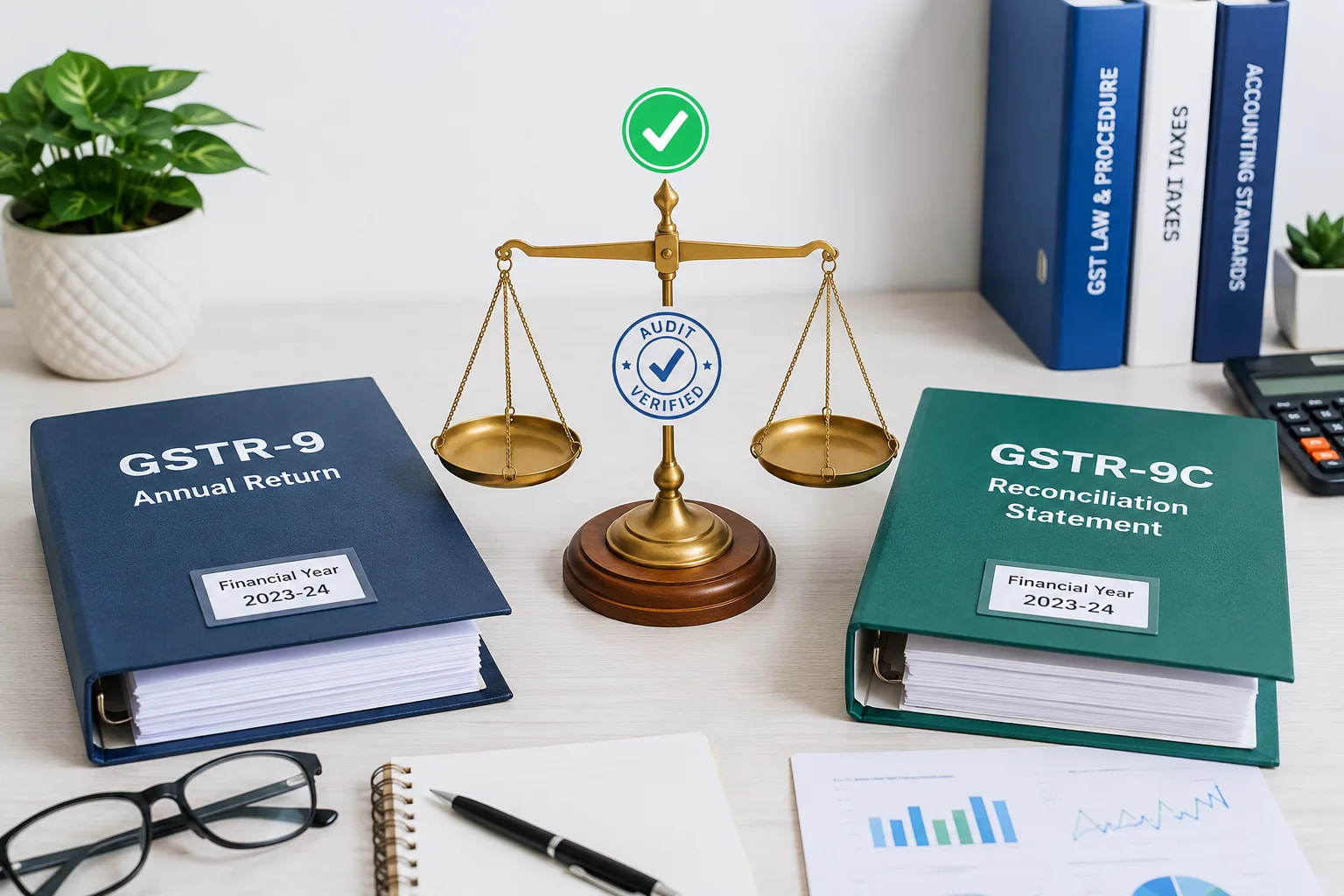
GSTR-9C is a self-certified reconciliation statement. It matches the figures in your GSTR-9 annual return with your audited financial statements, and explains any difference. You file it if your aggregate turnover in the financial year is above ₹5 crore. It is filed along with GSTR-9, by 31 December after the year ends.
- Who: aggregate turnover above ₹5 crore in that financial year.
- What: turnover, tax paid and input tax credit (ITC), matched against your audited accounts.
- Certification: you sign it yourself. A CA's certificate is not needed since 1 August 2021.
- When: with GSTR-9, by 31 December. GSTR-9 is filed first.
What is GSTR-9C?
GSTR-9C is a form under the GST law called a "reconciliation statement". "Reconcile" means to match two sets of numbers and explain why they differ.
Your GSTR-9 shows what you reported to the GST department during the year. Your audited financial statements show what your books say. GSTR-9C puts the two side by side for three things:
| What is matched | GST side | Books side |
|---|---|---|
| Turnover | Turnover declared in GSTR-9 | Turnover in the audited financial statements |
| Tax | Tax paid as per GSTR-9 | Tax payable on the turnover in your books |
| Input tax credit | ITC declared in GSTR-9 | ITC booked in your accounts |
Where the numbers do not match, you give the reason in the form. If the difference means you owe more tax, you show it as an additional liability and pay it.
The legal basis is section 44 of the CGST Act and rule 80(3) of the CGST Rules. Section 44 says the annual return may include a self-certified statement that reconciles the supplies declared in your returns with your audited annual financial statement.
GSTR-9C meaning in one line: it is the bridge between your GST returns and your audited books for one financial year.
GSTR-9C applicability: who has to file it
Under rule 80(3), you must file GSTR-9C if both of these are true:
- You are a registered person who files the GSTR-9 annual return, and
- Your aggregate turnover during that financial year is above ₹5 crore.
These registered persons do not file GSTR-9C even above ₹5 crore, because rule 80(3) leaves them out:
- Input Service Distributors
- Persons deducting tax at source (section 51) or collecting tax at source (section 52)
- Casual taxable persons and non-resident taxable persons
- A Department of the Central or State Government, or a local authority, whose books are audited by the CAG or by an auditor appointed for local authorities
How the ₹5 crore is counted. "Aggregate turnover" under section 2(6) of the CGST Act is counted for the whole PAN, across India. It adds up taxable supplies, exempt supplies, exports and inter-State supplies of all GSTINs under the same PAN. It does not include the GST itself, or purchases on which you paid tax under reverse charge.
So if your business has three GSTINs in three States and their combined turnover is above ₹5 crore, the limit is crossed. On our reading of rule 80(3), each of those GSTINs then files its own GSTR-9C, just as each GSTIN files its own GSTR-9.
GSTR-9C turnover limit by financial year
| Financial year | GSTR-9C needed if aggregate turnover is | Due date |
|---|---|---|
| 2025-26 | Above ₹5 crore | 31 December 2026 |
| 2024-25 | Above ₹5 crore | 31 December 2025 |
| 2023-24 | Above ₹5 crore | 31 December 2024 |
| 2022-23 | Above ₹5 crore | 31 December 2023 (10 January 2024 for notified Tamil Nadu districts) |
The ₹5 crore limit comes from rule 80(3) in the form set by Notification 30/2021-Central Tax dated 30 July 2021. The current rule text says the same.
Due dates are the rule dates. As of 3 October 2026, we found no extension for FY 2025-26. For extensions in past years, late fees and the three-year limit, see the GSTR-9 due date guide.
GSTR-9C and the ₹2 crore GSTR-9 exemption. From FY 2024-25, businesses with aggregate turnover up to ₹2 crore do not file GSTR-9 at all (Notification 15/2025-Central Tax). That has no effect on GSTR-9C, which starts only above ₹5 crore. The GSTR-9 vs GSTR-9C page has the full turnover table for both forms.
No CA certificate since 1 August 2021
Before August 2021, businesses above the limit had to get their accounts audited under section 35(5) of the CGST Act, and a Chartered Accountant or Cost Accountant certified the GSTR-9C. This was called the "GST audit".
The Finance Act 2021 changed this:
- Section 110 removed section 35(5), so the separate GST audit by a CA is gone.
- Section 111 rewrote section 44, so the annual return now includes a self-certified reconciliation statement.
- Both came into force on 1 August 2021 (Notification 29/2021-Central Tax).
Notification 30/2021-Central Tax then removed Part B (the auditor's certificate) from GSTR-9C. You now sign a declaration that the information is true and correct.
A CA's certificate is not required by law. You can still have a professional prepare the reconciliation. The figures must tie to your audited accounts, and you are responsible for them.
GSTR-9C format: parts and tables
GSTR-9C has the structure below. The form itself is in the CGST Rules, and the GST portal shows it when you prepare the return.
| Part | What it covers | Tables |
|---|---|---|
| Part I | Basic details: financial year, GSTIN, name | Tables 1 to 4 |
| Part II | Reconciliation of turnover in the audited financial statements with turnover in GSTR-9, and reasons for any difference | Tables 5 to 8 |
| Part III | Reconciliation of tax paid, reasons for differences, and additional tax payable but not paid | Tables 9 to 11 |
| Part IV | Reconciliation of input tax credit, and reasons for differences | Tables 12 to 16 |
| Part V | Additional liability due to non-reconciliation | Part V |
| Table 17 (from FY 2024-25) | Late fee payable and paid | Table 17 |
Two points from GSTN's FAQ for FY 2024-25:
- Table 12B is ITC booked in your accounts in an earlier year but claimed in this year's returns.
- If the ITC figures still do not match, you explain the reason in Table 13.
The ICAI also publishes a technical guide on the GST annual return. It is a professional guide, not the law.
GSTR-9C due date and late fee
GSTR-9C is due on the same day as GSTR-9: 31 December after the financial year ends. For FY 2025-26, that is 31 December 2026.
The late fee is not charged separately for each form. CBIC Circular 246/03/2025-GST says the late fee under section 47(2) is for the complete annual return, meaning GSTR-9 and GSTR-9C together. It runs from the due date until the day the complete annual return, including GSTR-9C, is filed.
From FY 2024-25, GSTR-9C has a Table 17 for this. The portal works out the late fee for the days between filing GSTR-9 (or the due date, if later) and filing GSTR-9C. GSTN's own example:
| GSTR-9 filed | GSTR-9C filed | Late fee days |
|---|---|---|
| 25 December 2025 | 7 January 2026 | 7 days, paid when filing GSTR-9C |
| 5 January 2026 | 7 January 2026 | 7 days in all: 5 paid with GSTR-9, 2 paid with GSTR-9C |
The per-day amounts and maximum caps by turnover are in the GSTR-9 due date guide.
How to file GSTR-9C
Before you start:
- File every GSTR-1 and GSTR-3B for the year. GSTR-9 cannot be filed until they are.
- File GSTR-9 for the same year. GSTR-9C cannot be filed before it.
- Keep your audited financial statements ready: balance sheet and profit and loss account.
Steps:
- Log in to the GST portal and open Annual Return for the financial year.
- Prepare GSTR-9C in GSTN's GSTR-9C offline tool, using your GSTR-9 figures and your audited accounts.
- Generate the JSON file from the offline tool.
- On the portal, upload the JSON file in GSTR-9C, along with the audited balance sheet, profit and loss account and any other document asked for.
- Check the details and the late fee in Table 17, if any.
- Sign and file with DSC or EVC, as the portal allows for your type of business.
Once filed, GSTR-9C cannot be revised. Check every table before you file. The steps to fill GSTR-9 itself are in how to file GSTR-9.
GSTR-9C errors while signing or uploading
People search for errors such as "initiate signing error", "emSigner error", "JSON generation error" and "upload error". The fix depends on your computer, browser, DSC and tool version, so we do not list fixes we have not checked against GSTN's own material.
What GSTN's material does say:
- The DSC is attached through emSigner, GSTN's signing utility.
If the error stays, use the official routes:
- GST helpdesk: 1800-103-4786
- Grievance Redressal Portal for GST: selfservice.gstsystem.in, where you can log the issue and track it.
Keep a screenshot of the error and note the time. Log the issue before the due date, so there is a dated record.
GSTR-9 vs GSTR-9C in short
GSTR-9 is the annual return. GSTR-9C is the reconciliation statement filed with it when turnover is above ₹5 crore. GSTR-9 is filed first, and both are due on 31 December. For the full comparison and the turnover table for both, see GSTR-9 vs GSTR-9C.
Frequently asked questions
What is GSTR-9C?
GSTR-9C is a self-certified reconciliation statement. It matches the turnover, tax and input tax credit in your GSTR-9 annual return with your audited financial statements, and explains any difference.
What is the GSTR-9C turnover limit?
GSTR-9C applies when your aggregate turnover in the financial year is above ₹5 crore (rule 80(3) of the CGST Rules). Up to ₹5 crore, it is not required.
Who is required to file GSTR-9C?
Every registered person who files GSTR-9 and has aggregate turnover above ₹5 crore in that year. Input Service Distributors, TDS and TCS deductors, casual and non-resident taxable persons, and CAG-audited Government departments do not file it.
What is the GSTR-9C applicability for FY 2023-24?
For FY 2023-24, GSTR-9C applies if aggregate turnover in FY 2023-24 was above ₹5 crore. The due date under the rule was 31 December 2024.
What is the GSTR-9C applicability for FY 2022-23?
For FY 2022-23, GSTR-9C applies if aggregate turnover in FY 2022-23 was above ₹5 crore. The due date was 31 December 2023, or 10 January 2024 for notified Tamil Nadu districts.
Does GSTR-9C still need a CA certificate?
No. Since 1 August 2021, GSTR-9C is self-certified. You sign the declaration yourself. A CA can still prepare it for you, but the law does not need a CA's certificate.
What is the GSTR-9C due date?
31 December after the end of the financial year, the same as GSTR-9. For FY 2025-26, it is 31 December 2026. As of 3 October 2026, no extension had been announced.
Is the ₹5 crore limit per GSTIN or per PAN?
Per PAN. Aggregate turnover adds up all GSTINs under the same PAN across India. If the total is above ₹5 crore, the limit is crossed for each of those GSTINs.
Can I file GSTR-9C before GSTR-9?
No. GSTR-9 for the same year must be filed first. GSTR-9C is filed after it, by the same due date.
Can GSTR-9C be revised after filing?
No. GSTN's FAQ says GSTR-9C cannot be revised once filed. GSTR-9 cannot be revised either, so check both carefully before filing.
Is there a late fee for GSTR-9C?
Yes. The late fee is for the complete annual return, which includes GSTR-9C. It runs until GSTR-9C is filed. From FY 2024-25, it is shown in Table 17 of GSTR-9C.
What documents are uploaded with GSTR-9C?
The audited balance sheet and profit and loss account, along with the GSTR-9C JSON file from the offline tool. The portal may ask for other related documents.
What should I do if I get an error while signing GSTR-9C?
Note the error and the time, and contact the GST helpdesk on 1800-103-4786 or log it on the Grievance Redressal Portal for GST. Do it before the due date, so you have a record.
Hinglish mein sawaal
GSTR-9C kya hai aur kisko file karna hota hai?
GSTR-9C ek self-certified reconciliation statement hai. Isme aapke GSTR-9 ke figures ko audited accounts se match kiya jata hai. Jinka aggregate turnover saal mein ₹5 crore se zyada hai, unhe GSTR-9 ke saath GSTR-9C file karna hota hai.
GSTR-9C ki turnover limit kitni hai?
₹5 crore. Agar financial year mein aapka aggregate turnover (PAN ke sabhi GSTIN mila kar) ₹5 crore se zyada hai, to GSTR-9C file karna zaroori hai.
Last reviewed: 3 October 2026
FilingSetu is the brand of ANR Consultancy, a partnership firm.
GSTIN: 07ACOFA0324K1ZG
This page explains the law as it stands on the review date. It is not advice on your specific case.