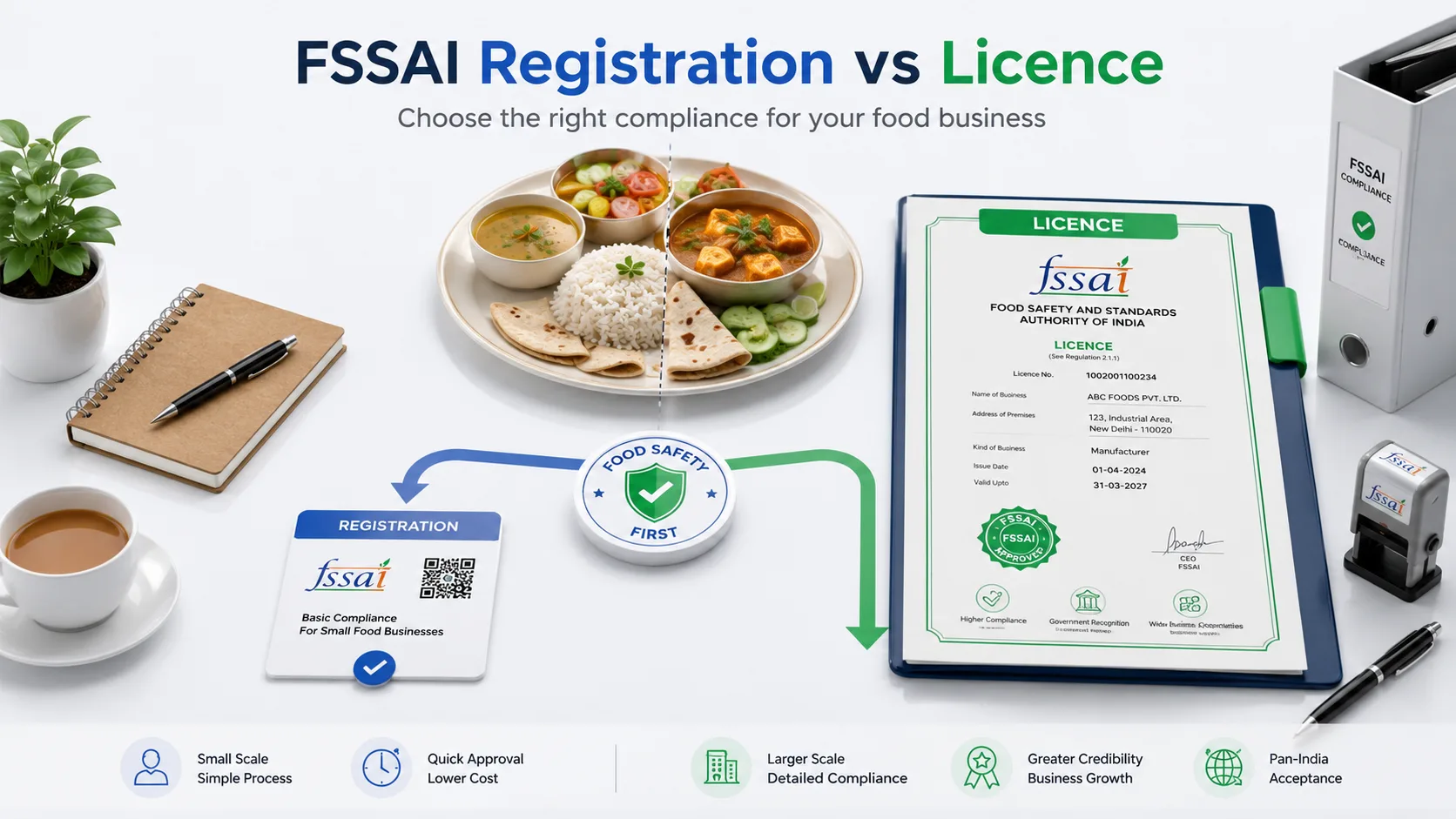
Any business that makes, stores, transports or sells food needs an FSSAI authorisation — but there are three tiers, and using the wrong one is a compliance risk. Which you need comes down to turnover and scale. This guide sets out the three tiers, the turnover bands, the documents, and why the wrong tier can mean penalties and seizure.
- Every food business needs FSSAI — the tier depends on turnover and scale.
- Basic registration: up to ₹1.5 crore turnover (from 1 April 2026).
- State licence: above ₹1.5 crore and up to ₹50 crore; Central licence: above ₹50 crore, importers, multi-state.
- The 14-digit FSSAI number must be displayed on packaging and premises.
The three FSSAI tiers
| Tier | Turnover | Typical business |
|---|---|---|
| Basic registration | Up to ₹1.5 crore | Home kitchens, small stalls |
| State licence | Above ₹1.5 crore and up to ₹50 crore | Restaurants, mid-size manufacturers |
| Central licence | Above ₹50 crore | Large units, importers, multi-state |
The tiers in detail
- Basic registration: small operators with turnover up to ₹1.5 crore.
- State licence: mid-sized businesses, turnover above ₹1.5 crore and up to ₹50 crore.
- Central licence: large operators above ₹50 crore, importers and multi-state businesses (which need central plus state licences per location).
“Every food business needs FSSAI. Turnover, not the type of food, decides which of the three tiers applies to you.”
Frequently asked questions
How long is an FSSAI licence valid?
FSSAI's press release of 13 March 2026 says registrations and licences have perpetual validity from 1 April 2026, so they no longer need renewal.
What if my turnover grows past a tier?
You upgrade to the higher tier. Continuing on a lower tier once you cross the band is a compliance breach.
Do home-based and online food sellers need FSSAI?
Yes. See our guide on FSSAI for cloud kitchens and home food sellers.
Running a cloud kitchen or selling food online? See our FSSAI for online food guide. Our FSSAI registration service assesses your tier and files it. Explore all registration services.