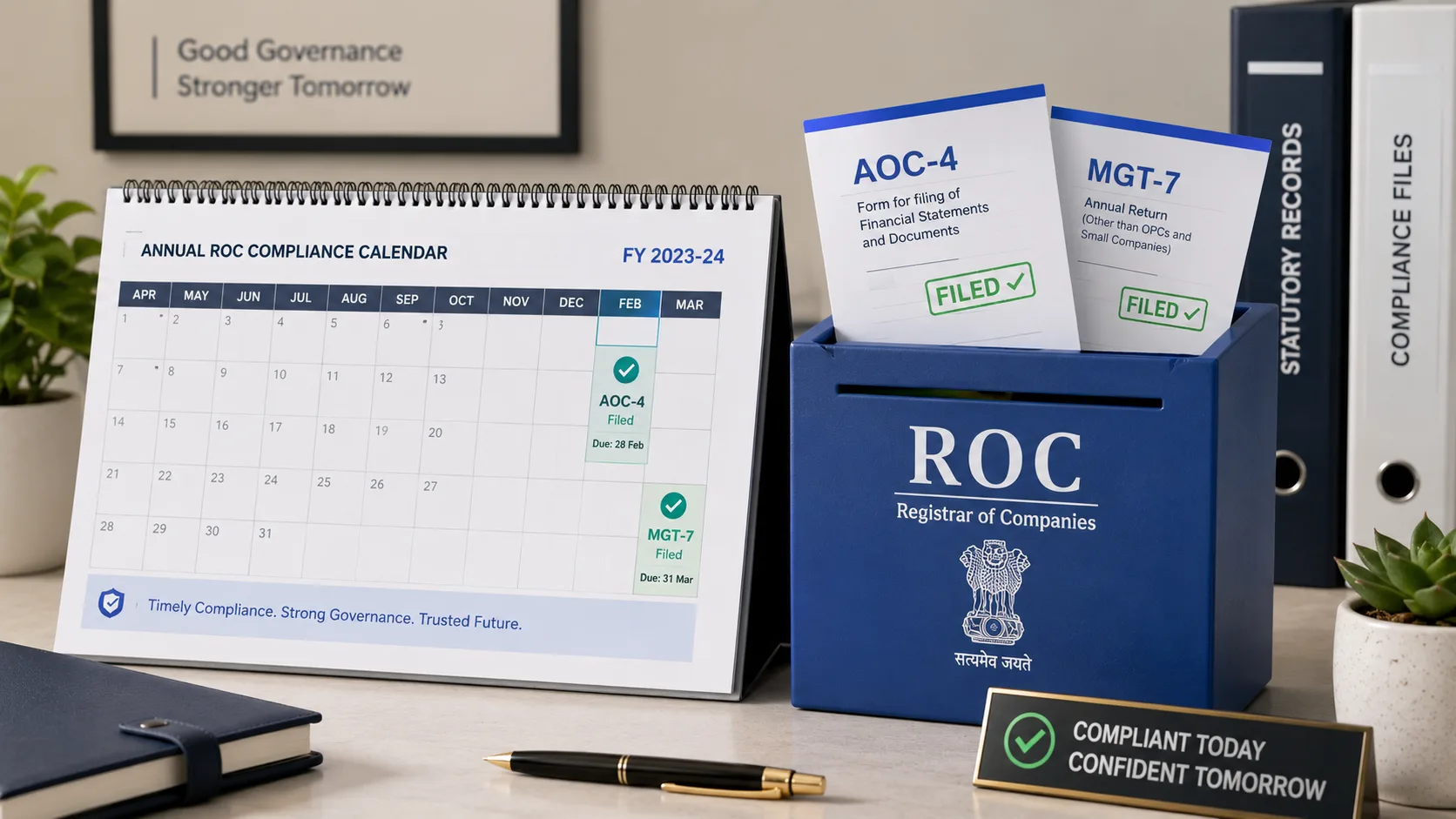
Every private limited company holds its AGM within six months of the year end, by 30 September for most companies. It then files its financial statements in Form AOC-4 within 30 days of the AGM, and its annual return in Form MGT-7 (MGT-7A for small companies) within 60 days. A late form costs ₹100 a day.
- For FY 2025-26, the AGM was due by 30 September 2026. AOC-4 is due within 30 days of your AGM and MGT-7 within 60 days.
- AOC-4 carries the financial statements. MGT-7 is the annual return with shareholding and director details.
- Each late form costs an extra ₹100 a day, with no upper limit in the fee rules. Penalties under the Companies Act can be added on top.
- Directors of a company that does not file for three years in a row are disqualified for five years.
- DIR-3 KYC is now due once every three years, not every year.
ROC filing due dates for FY 2025-26
For a company whose financial year ended on 31 March 2026:
| What | Due date | Law |
|---|---|---|
| AGM | 30 September 2026 (within 6 months of the year end) | Section 96 |
| AOC-4 (financial statements) | Within 30 days of the AGM | Section 137 |
| MGT-7 or MGT-7A (annual return) | Within 60 days of the AGM | Section 92(4) |
| ADT-1 (auditor appointment) | Within 15 days of the meeting that appoints the auditor. Only in a year when an auditor is appointed | Section 139(1) |
| DPT-3 (return of deposits) | 30 June every year, with figures as on 31 March | Rule 16, Acceptance of Deposits Rules |
| MSME Form I (if you owe micro or small suppliers for over 45 days) | 31 October (April to September) and 30 April (October to March) | MCA order, 22 January 2019 |
| DIR-3 KYC (each director) | Once every three financial years, by 30 June of the next year | Rule 12A, Appointment and Qualification of Directors Rules |
If your AGM was earlier than 30 September, count from your own AGM date. The dates run from the meeting, not from 30 September.
If the AGM was not held: file AOC-4 within 30 days of the last date the AGM should have been held, with a statement of facts and reasons for not holding it (section 137(2)). File MGT-7 within 60 days of that date (section 92(4)).
One Person Company: an OPC does not hold an AGM. It files AOC-4 within 180 days from the end of the financial year (section 137(1)). See our OPC annual filing page.
New company: the first AGM can be held within nine months from the end of the first financial year (section 96(1)).
For all due dates across GST, TDS, income tax and ROC, use our due date calendar.
Has the ROC due date been extended in 2026?
As of 10 October 2026, we found no MCA circular that extends the FY 2025-26 due dates for AOC-4 or MGT-7. Check the MCA website before you rely on any extension you read about.
For FY 2024-25, MCA let companies file AOC-4, MGT-7 and MGT-7A without additional fees up to 31 December 2025 (General Circular 06/2025, 17 October 2025), and then up to 31 January 2026 (General Circular 08/2025, 30 December 2025). That relief has ended.
Extending your own AGM: the Registrar can, for a special reason, extend the time for an AGM (other than the first AGM) by up to three months (section 96(1)). You apply in Form GNL-1. The extension is not automatic. Keep the Registrar's order.
The forms a private limited company files every year
| Form | What it is | Who files |
|---|---|---|
| AOC-4 | Financial statements (balance sheet, profit and loss, cash flow where needed) with the board's report and auditor's report | Every company. Larger companies file it as AOC-4 XBRL. Companies with subsidiaries also file AOC-4 CFS |
| MGT-7 | Annual return: shareholding, directors, meetings and other details for the year | Every company except OPCs and small companies |
| MGT-7A | Shorter annual return | OPCs and small companies |
| DPT-3 | Return of deposits, and of money received that is not a deposit | Every company other than a Government company |
| MSME Form I | Half-yearly return of dues to micro and small suppliers over 45 days | Only if you have such dues. See our MSME 45 days payment rule guide |
| ADT-1 | Notice of auditor appointment | Only when an auditor is appointed (first AGM, then usually every five years) |
| DIR-3 KYC | KYC of each director | Every three years (see below) |
For the full list of ROC forms, including event forms like DIR-12 and SH-7, read our ROC forms guide.
DIR-3 KYC, new rule from 31 March 2026: each director now files DIR-3 KYC once every three financial years, by 30 June of the year after the third year. If the director's mobile number, email or address changes, update it within 30 days. Filing within the time limit is free. Late filing, or filing to reactivate a DIN, costs ₹5,000. Each update filing costs ₹500.
AOC-4 and MGT-7: what is the difference?
| AOC-4 | MGT-7 / MGT-7A | |
|---|---|---|
| What it carries | The financial statements | The annual return |
| Section | 137 | 92 |
| Due | 30 days from the AGM | 60 days from the AGM |
| Main content | Balance sheet, profit and loss, board's report, auditor's report | Shareholders, directors, meetings, transfers, remuneration and similar details |
| Late fee | ₹100 a day | ₹100 a day |
Who files MGT-7A: OPCs and small companies. From 1 December 2025, a small company is a private company with paid-up capital of up to ₹10 crore and turnover of up to ₹100 crore (it was ₹4 crore and ₹40 crore before). A holding or subsidiary company, a Section 8 company and a company under a special Act cannot be a small company, so they file MGT-7.
Who signs MGT-7A: for an OPC or small company, the company secretary signs the annual return, or a director if there is no company secretary (section 92(1)).
MGT-8: a listed company, or a company with paid-up capital of ₹10 crore or more, or turnover of ₹50 crore or more, must get its annual return certified by a company secretary in practice in Form MGT-8 (rule 11(2)).
AOC-4 XBRL: listed companies and their Indian subsidiaries, companies with paid-up capital of ₹5 crore or more, companies with turnover of ₹100 crore or more, and companies that follow Ind AS file their financial statements in XBRL format. Banking, insurance and some financial companies are left out (XBRL Rules, rule 3).
Late fees and penalties for ROC filing
There are three separate costs if AOC-4 or MGT-7 is late.
1. Additional fee: ₹100 a day, for each form. For AOC-4 and MGT-7 due after 30 June 2018, the fee rules charge an additional fee of ₹100 for every day of delay. The fee rules set no upper limit. You pay it on top of the normal filing fee, when you file.
Example: AOC-4 filed 40 days late costs ₹4,000 in additional fee plus the normal fee. If MGT-7 is also 40 days late, that is another ₹4,000.
The “2 times to 12 times the normal fee” table you may see elsewhere is for other forms. It does not apply to AOC-4 or MGT-7.
2. Penalty under the Companies Act. This is separate from the fee. The Registrar can impose it by an order.
| Default | Company | Officer in default |
|---|---|---|
| AOC-4 late (section 137(3)) | ₹10,000, plus ₹100 a day while it continues, up to ₹2 lakh | Managing director and CFO (or the directors the section names): ₹10,000, plus ₹100 a day, up to ₹50,000 |
| MGT-7 late (section 92(5)) | ₹10,000, plus ₹100 a day while it continues, up to ₹2 lakh | ₹10,000, plus ₹100 a day, up to ₹50,000 |
3. Director disqualification. If a company has not filed financial statements or annual returns for any three financial years in a row, every person who is its director cannot be re-appointed in that company, or appointed in any other company, for five years (section 164(2)(a)). A person newly appointed to such a company gets six months before this applies.
Strike off: if a company has not carried on business for the two years just before, and has not applied for dormant status, the Registrar can remove its name from the register (section 248(1)(b)).
CCFS-2026: the late fee waiver scheme
The Companies Compliance Facilitation Scheme, 2026 (CCFS-2026) was a one-time scheme by MCA for companies with pending annual filings (General Circular 01/2026, 24 February 2026).
- Period: 15 April 2026 to 15 July 2026, extended to 31 August 2026 (General Circular 03/2026) and then to 15 September 2026 (General Circular 04/2026).
The scheme closed on 15 September 2026. As of 10 October 2026, we found no further extension. A company with old pending filings now pays the full ₹100 a day additional fee. If you still have pending years, talk to us before you file, because penalty notices may also apply.
How to check a company's annual filing status
Use the Check Annual Filing Status service on the MCA website with the company's CIN.
The company's master data on the MCA website also shows the date of its last AGM and the date of its latest balance sheet on record. If the two sources differ, check both.
AGM rules in short
- Every company except an OPC must hold an AGM each year (section 96(1)).
- It must be within six months of the year end. Not more than 15 months can pass between two AGMs.
- The first AGM can be within nine months of the end of the first financial year. No AGM is needed in the year of incorporation if the first AGM is held in this time.
- The AGM must be held in business hours, between 9 am and 6 pm, on any day that is not a National Holiday (section 96(2)). So a Sunday is allowed if it is not a National Holiday.
- The Registrar can extend the time by up to three months (not for the first AGM) on an application in GNL-1.
Annual compliance checklist for a private limited company
| Item | When | Law |
|---|---|---|
| Board meetings | At least four a year, with not more than 120 days between two meetings. Small companies, OPCs, dormant companies and start-up private companies: at least one in each half of the calendar year, at least 90 days apart | Section 173 |
| Statutory audit | Every year, by the auditor appointed at the AGM | Sections 139 and 143 |
| Financial statements and board's report | Approved by the board, then laid before the AGM | Section 134 |
| AGM | Within six months of the year end | Section 96 |
| AOC-4 | Within 30 days of the AGM | Section 137 |
| MGT-7 / MGT-7A | Within 60 days of the AGM | Section 92 |
| DPT-3 | By 30 June | Rule 16, Deposits Rules |
| MSME Form I | 31 October and 30 April, if applicable | MCA order, 2019 |
| ADT-1 | Within 15 days of an auditor's appointment | Section 139 |
| DIR-3 KYC | Once in three financial years, by 30 June | Rule 12A |
Income tax and GST returns are separate filings and are not filed with the ROC.
Want us to handle it? See our annual ROC filing service.
FAQs
Is ROC filing mandatory every year?
Yes. Every company must file its financial statements (AOC-4) and annual return (MGT-7 or MGT-7A) every year. This applies even if the company had no business or zero turnover in the year.
What is the due date for AOC-4 and MGT-7 for FY 2025-26?
AOC-4 is due within 30 days of the AGM and MGT-7 within 60 days. Count from the date your AGM was held.
Has MCA extended the ROC due date in 2026?
As of 10 October 2026, we found no extension for FY 2025-26 filings. The last relief, for FY 2024-25 filings, ended on 31 January 2026.
What is the late fee for AOC-4 and MGT-7?
₹100 for each day of delay, for each form, on top of the normal fee. The fee rules set no upper limit.
What happens if ROC filing is not done?
The company pays ₹100 a day per form when it finally files. The Registrar can also impose a penalty of up to ₹2 lakh on the company and up to ₹50,000 on officers. After three years of not filing, the directors are disqualified for five years.
What is the difference between AOC-4 and MGT-7?
AOC-4 files the financial statements with the Registrar. MGT-7 files the annual return, with details of shareholders, directors and meetings.
Who files MGT-7A?
OPCs and small companies. A small company now has paid-up capital of up to ₹10 crore and turnover of up to ₹100 crore.
Is ADT-1 filed every year?
No. ADT-1 is filed within 15 days of the meeting that appoints the auditor. An auditor appointed at an AGM holds office till the sixth AGM, so most companies file it once in five years.
Is DIR-3 KYC still due every year?
No. From 31 March 2026, each director files it once every three financial years, by 30 June. Changes in mobile number, email or address must be updated within 30 days.
Can the AGM be held on a Sunday?
Yes, if that Sunday is not a National Holiday. The AGM must be held between 9 am and 6 pm.
What was CCFS-2026?
A one-time MCA scheme that let companies file pending annual forms at a reduced additional fee. It closed on 15 September 2026.
How do I check whether a company has filed its annual returns?
Use the Check Annual Filing Status service on the MCA website with the company's CIN.
Hinglish mein sawaal
AOC-4 aur MGT-7 ki last date kya hai?
AGM ke 30 din ke andar AOC-4 aur 60 din ke andar MGT-7. Ginti apne AGM ki date se karein.
ROC filing late ho gayi to kitni fees lagegi?
Har form par ₹100 roz extra fee, normal fee ke upar. Iski koi upper limit nahi hai. Registrar alag se penalty bhi laga sakta hai.
Last reviewed: 10 October 2026
FilingSetu is the brand of ANR Consultancy, a partnership firm.
GSTIN: 07ACOFA0324K1ZG
This page explains the law as it stands on the review date. It is not advice on your specific case.