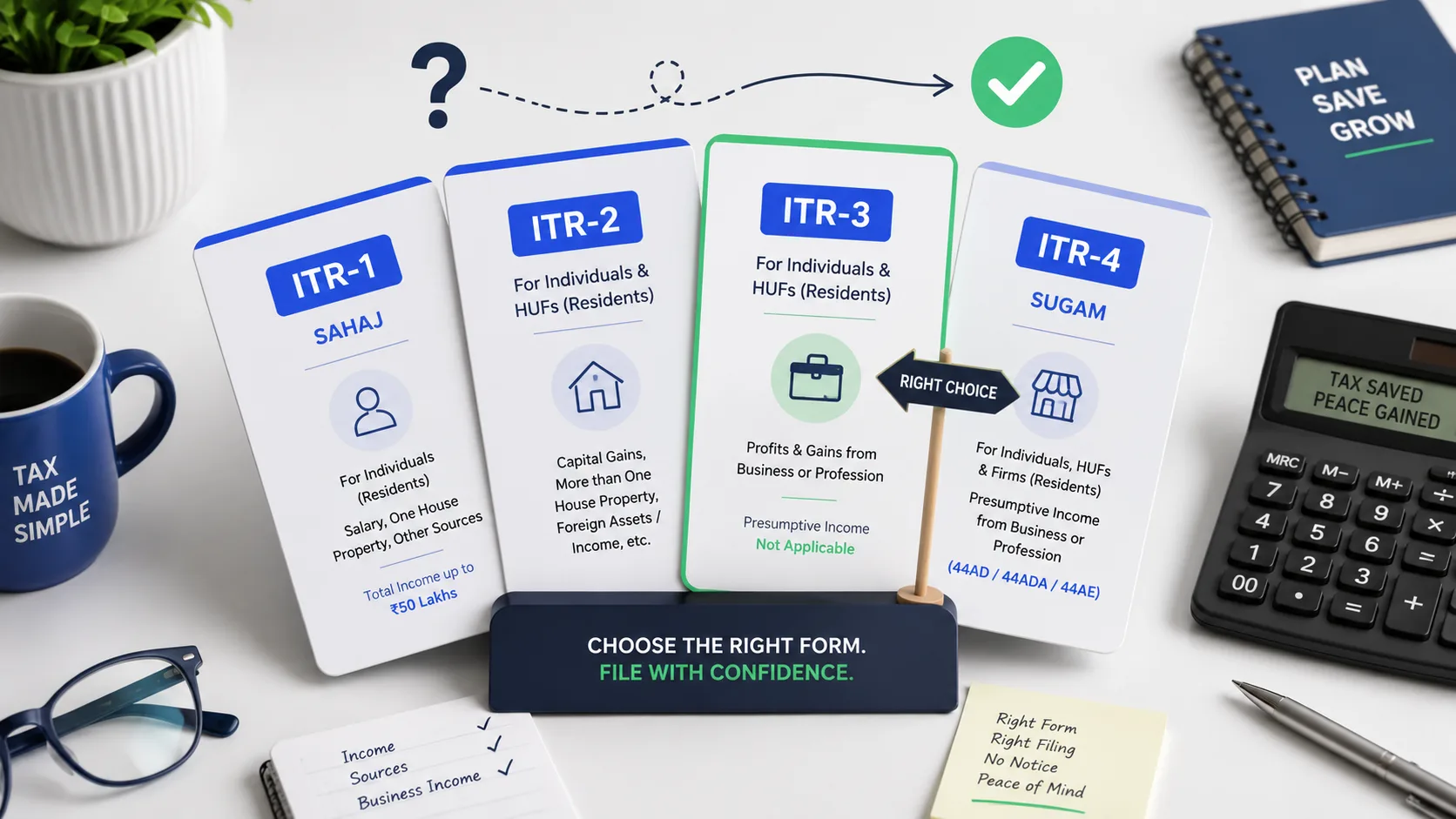
For AY 2026-27, individuals and HUFs file one of four forms. Use ITR-1 if you are a resident with income up to ₹50 lakh from salary or pension, up to two house properties, and interest. Use ITR-2 if you have capital gains or other income ITR-1 cannot take, but no business. Use ITR-3 for business or profession income. Use ITR-4 for presumptive business income.
Which ITR to file: the quick answer
| Your situation | Form |
|---|---|
| Resident, income up to ₹50 lakh, from salary or pension, up to two house properties, interest or dividend | ITR-1 (Sahaj) |
| No business income, but you cannot use ITR-1 (for example, short-term capital gains, income above ₹50 lakh, a third house property, or you are an NRI) | ITR-2 |
| Income from business or profession, and you cannot or do not want to use ITR-4 | ITR-3 |
| Resident, income up to ₹50 lakh, business or profession income on a presumptive basis (section 44AD, 44ADA or 44AE) | ITR-4 (Sugam) |
| Firm, LLP, AOP, BOI, co-operative society, or trust that does not file ITR-7 | ITR-5 |
| Company (other than one claiming exemption under section 11) | ITR-6 |
| Charitable or religious trust, political party, university, research association and similar bodies | ITR-7 |
Individuals and HUFs choose from ITR-1 to ITR-4. Firms, companies, trusts and other bodies use ITR-5, ITR-6 or ITR-7, though a firm (not an LLP) with presumptive income can use ITR-4. An HUF can never use ITR-1, because ITR-1 is for individuals only.
How to select ITR-1, 2, 3 or 4: four questions
Answer these in order. Stop at the first form that fits.
- Do you have income from a business or profession? If yes, go to question 3. If no, go to question 2.
- Can you use ITR-1? You can if all of these are true: you are a resident (not a "not ordinarily resident"), your total income is up to ₹50 lakh, and your income is only from salary or pension, up to two house properties, other sources such as interest and dividends, long-term capital gains under section 112A up to ₹1.25 lakh, and agricultural income up to ₹5,000. If any one of these fails, or you are in the "cannot use ITR-1" list below, file ITR-2.
- Is your business income presumptive, under section 44AD, 44ADA or 44AE? If yes, and you are a resident with total income up to ₹50 lakh, and none of the exclusions below applies, you can use ITR-4. ITR-4 is optional, so you can still choose ITR-3.
- Everyone else with business or profession income files ITR-3.
Still not sure? The e-filing portal can help. Log in, go to e-File > Income Tax Returns > File Income Tax Return, and choose the option that helps you decide. It asks about your residential status, house property, business and income, and then shows the form that applies.
Who cannot use ITR-1
Even with a small salary, you cannot use ITR-1 if any of these apply:
- You were a director in a company during the year.
- You held unlisted equity shares at any time during the year.
- You have any asset or income outside India, or signing authority in an account outside India.
- You have short-term capital gains, or long-term capital gains under section 112A above ₹1.25 lakh.
- You have income from more than two house properties.
- You have losses brought forward from earlier years.
- Tax was deducted under section 194N, or you have deferred tax on ESOPs.
- Your total income is above ₹50 lakh, or your agricultural income is above ₹5,000.
The full list is in the official ITR-1 FAQ.
New for AY 2026-27: ITR-1 now takes income from up to two house properties. Earlier it allowed only one. Some older pages, including one portal guide, still say one house property. The ITR-1 FAQ for AY 2026-27 says two.
ITR-1 vs ITR-4: what is the difference?
ITR-4 is ITR-1 plus presumptive business income. Both are for residents with total income up to ₹50 lakh.
| ITR-1 (Sahaj) | ITR-4 (Sugam) | |
|---|---|---|
| Who can file | Resident individuals | Resident individuals, HUFs, and firms other than LLPs |
| Business or profession income | ✗ | Yes, if computed on a presumptive basis under 44AD, 44ADA or 44AE |
| Salary, up to two house properties, interest | Yes | Yes |
| LTCG under 112A up to ₹1.25 lakh | Yes | Yes |
| Short-term capital gains | ✗ | ✗ |
ITR-1 vs ITR-2: what is the difference?
Both forms are for people with no business income. ITR-2 is wider.
| ITR-1 (Sahaj) | ITR-2 | |
|---|---|---|
| Who can file | Resident individuals only | Individuals and HUFs, resident or not |
| Total income limit | Up to ₹50 lakh | No limit |
| House property | Up to two | Any number |
| Capital gains | Only LTCG under section 112A, up to ₹1.25 lakh | All capital gains |
| Foreign income or assets | ✗ | Yes |
| Company director, unlisted shares | ✗ | Yes |
| Business or profession income | ✗ | ✗ |
So, should you file ITR-1 or ITR-2? If you fit every ITR-1 condition, ITR-1 is the simpler form. If even one condition fails, ITR-2 is the right form.
ITR-3 vs ITR-4: what is the difference?
Both are for business or profession income. The difference is how the income is worked out.
We file both: see ITR filing for business owners.
| ITR-3 | ITR-4 (Sugam) | |
|---|---|---|
| Business income | Any business or profession income | Only presumptive income under 44AD, 44ADA or 44AE |
| Who can file | Individuals and HUFs | Resident individuals, HUFs, and firms other than LLPs |
| Total income limit | No limit | Up to ₹50 lakh |
| Capital gains | All | Only LTCG under 112A up to ₹1.25 lakh |
| Directors, unlisted shares, foreign income | Allowed | ✗ |
| Is it compulsory? | Yes, if you cannot use ITR-4 | No. ITR-4 is optional |
If you are not sure whether your income qualifies as presumptive, read our guide to presumptive taxation under section 44AD and 44ADA.
ITR-2 vs ITR-3: what is the difference?
The only question is business income. ITR-2 has no place for income from business or profession. The moment you have any, you move to ITR-3 (or ITR-4, if you qualify). ITR-3 also covers salary, house property, capital gains and other sources, so you report all your income on the one form.
Which ITR to file for a salaried person
A salaried person with no business income files ITR-1 or ITR-2. Pick like this:
| Salaried person with... | Form |
|---|---|
| Only salary and bank interest, total income up to ₹50 lakh | ITR-1 |
| Salary and rent from one or two houses | ITR-1 |
| Salary and rent from three or more houses | ITR-2 |
| Salary and gains from selling shares or mutual funds held for a short term | ITR-2 |
| Salary and long-term gains on listed shares or equity funds (section 112A) up to ₹1.25 lakh | ITR-1 |
| Salary above ₹50 lakh | ITR-2 |
| Salary and a directorship, or unlisted shares | ITR-2 |
| Salary and freelance or business income on the side | ITR-3, or ITR-4 if the side income is presumptive |
Every ITR-1 row assumes the other ITR-1 conditions are also met: resident, total income up to ₹50 lakh, and nothing from the "cannot use ITR-1" list.
Want a CA to file it for you? See ITR filing for salaried employees.
This is why the answer to "which ITR to file for a salaried person with capital gains" depends on the kind of gain. Long-term gains under section 112A up to ₹1.25 lakh fit in ITR-1. Short-term gains, or bigger long-term gains, need ITR-2.
Which ITR for other common situations
| Situation | Form |
|---|---|
| Pensioner with pension and fixed deposit interest, income up to ₹50 lakh | ITR-1 |
| NRI with rent or interest from India, no business | ITR-2 |
| Freelancer or consultant using section 44ADA | ITR-4 if eligible, otherwise ITR-3 |
| Freelancer or consultant keeping full books | ITR-3 |
| Shop owner using section 44AD | ITR-4 if eligible, otherwise ITR-3 |
| Agricultural income above ₹5,000, no business | ITR-2 |
| HUF with no business income | ITR-2 |
| Partnership firm | ITR-5, or ITR-4 if it qualifies for presumptive income |
| LLP | ITR-5 |
| Private or public limited company | ITR-6, unless it claims exemption under section 11 |
| Charitable or religious trust filing under section 139(4A) | ITR-7 |
If you are 75 or older, you may not need to file at all. That applies if you are a resident, your only income is pension and interest from the same bank that pays your pension, and you have given that bank the required declaration. The bank must be one notified by the government, and it deducts your tax. See section 194P for those aged 75 and above.
For more on the self-employed, see ITR filing for freelancers and the self-employed.
ITR-5, ITR-6 and ITR-7: forms for firms, companies and trusts
These three are not for individuals.
- ITR-5 is for firms (including LLPs), associations of persons (AOP), bodies of individuals (BOI), artificial juridical persons, local authorities, co-operative societies, and trusts that do not file ITR-7.
- ITR-6 is for companies, other than those claiming exemption under section 11.
- ITR-7 is for persons, including companies, that must file under section 139(4A), 139(4B), 139(4C) or 139(4D). In plain words: property held under trust for charitable or religious purposes, political parties, bodies such as research associations and news agencies, and universities, colleges and similar institutions.
Check your AIS before you pick
Your form depends on your income, so first see all of it. Your Annual Information Statement (AIS) shows the information the department holds about you. Log in at incometax.gov.in and open it from the Dashboard, or from e-File > Income Tax Return > View AIS. An entry you forgot, such as a share sale, can change your form from ITR-1 to ITR-2.
Due dates for AY 2026-27
The due date depends on your kind of income, not on the form number.
| Who | Due date |
|---|---|
| No business or profession income (ITR-1 and ITR-2 filers) | 31 July 2026 |
| Business or profession income, accounts not required to be audited (ITR-3 and ITR-4 filers without audit) | 31 August 2026 |
| Accounts that must be audited, and companies | 21 November 2026 (extended by CBDT from 31 October 2026) |
If you missed your due date, you can still file a belated return by 31 December 2026, or before your assessment is completed, whichever is earlier. See our belated return filing service.
What if you filed the wrong ITR form?
You can file a revised return on the correct form, as long as the time to revise has not passed and no assessment is completed. For AY 2026-27 that is until 31 March 2027, with a fee after 31 December 2026. Our revised return guide explains the steps.
If the department finds your return incomplete or inconsistent, it can send a defective return notice under section 139(9). You then get 15 days from receiving the notice, or the time given in the notice, to fix it. You can file a fresh or revised return if the filing time for that year has not ended, or reply to the notice.
Which law these forms come under
The Income-tax Act, 2025 came into force on 1 April 2026. But returns for AY 2026-27 (the financial year 2025-26) are still filed on the seven forms under the Income-tax Act, 1961. That is why this page uses 1961 Act section numbers such as 44AD and 112A. Returns for tax year 2026-27, filed in 2027, fall under the 2025 Act. Check the form rules again for that year.
Want us to file it for you?
If you would rather not choose the form yourself, our ITR filing service does it for you. We pick the form, and a chartered accountant checks every return before it is filed. Plans start at ₹899 + GST for salary and pension returns (ITR-1 or ITR-2), ₹1,149 + GST for presumptive income under section 44AD or 44ADA (ITR-4), and ₹2,299 + GST for business income with books (ITR-3), both without audit. If your income falls under two plans, you pay only for the higher one. Help with e-verification is included.
Prefer to do it yourself? Our step-by-step ITR filing guide walks you through the portal.
Frequently asked questions
Which ITR should I file?
It depends on where your income comes from. Salary, up to two house properties and interest, with income up to ₹50 lakh, means ITR-1 if you meet the other ITR-1 conditions. Capital gains or other income that ITR-1 cannot take, with no business, means ITR-2. Business income means ITR-3, or ITR-4 if it is presumptive.
How to select ITR 1 or 2 or 3?
First ask if you have business or profession income. If yes, it is ITR-3 (or ITR-4 for presumptive income). If no, check the ITR-1 conditions. If you meet all of them, file ITR-1. If not, file ITR-2.
Should I file ITR 1 or 2?
File ITR-1 if you are a resident with total income up to ₹50 lakh from salary, up to two house properties, interest, and long-term gains under section 112A up to ₹1.25 lakh. If you have short-term capital gains, foreign income, more than two house properties or income above ₹50 lakh, file ITR-2.
What is the difference between ITR-1 and ITR-4?
ITR-1 is for residents with salary, pension, up to two house properties and interest, and no business income. ITR-4 takes all of that plus business or profession income worked out on a presumptive basis under section 44AD, 44ADA or 44AE. Both have a ₹50 lakh total income limit.
Who can file ITR 1, 2, 3, 4, 5?
ITR-1: resident individuals with simple income up to ₹50 lakh. ITR-2: individuals and HUFs with no business income who cannot use ITR-1. ITR-3: individuals and HUFs with business or profession income. ITR-4: residents with presumptive business income up to ₹50 lakh. ITR-5: firms, LLPs, AOPs, BOIs and co-operative societies.
What is ITR-1, ITR-2, ITR-3 and ITR-4?
They are the four ITR forms individuals use. ITR-1 (Sahaj) is the simplest, for salary and similar income. ITR-2 adds capital gains and foreign income. ITR-3 covers business and profession income. ITR-4 (Sugam) is a simple form for presumptive business income.
How many types of ITR forms are there?
There are seven ITR forms for AY 2026-27, ITR-1 to ITR-7. Individuals and HUFs use ITR-1 to ITR-4. Firms, companies, trusts and other bodies use ITR-5, ITR-6 and ITR-7, though a firm (not an LLP) with presumptive income can use ITR-4.
Can a salaried person with share gains use ITR-1?
Only if the gains are long-term gains under section 112A of up to ₹1.25 lakh and there are no short-term gains. Any short-term capital gain, or a bigger long-term gain, means ITR-2.
Can I file ITR-1 with two house properties?
Yes, for AY 2026-27. ITR-1 now allows income from up to two house properties. With three or more, you need ITR-2 (or ITR-3 if you also have business income).
What is the difference between ITR-3 and ITR-4?
ITR-4 is only for presumptive business income under 44AD, 44ADA or 44AE, for residents with income up to ₹50 lakh. ITR-3 covers any business or profession income, with no income limit. ITR-4 is optional, so an eligible person can still file ITR-3.
Which ITR form do freelancers use?
A freelancer who uses presumptive income under section 44ADA can use ITR-4, if eligible. A freelancer who keeps full books, or does not qualify for ITR-4, files ITR-3. A freelancer never uses ITR-1 or ITR-2 for freelance income.
Which ITR should an NRI file?
An NRI cannot use ITR-1 or ITR-4. With no business income in India, an NRI files ITR-2. With business or profession income, an NRI files ITR-3.
Is there a tool on the income tax portal to find my ITR form?
Yes. Log in to the e-filing portal and go to e-File > Income Tax Returns > File Income Tax Return. Choose the option that helps you decide, and answer the questions on residential status, house property, business and income.
Hinglish mein sawaal
Mujhe kaunsa ITR form bharna chahiye?
Agar sirf salary, do ghar tak ka kiraya aur bank interest hai, aur income ₹50 lakh tak hai, to ITR-1. Capital gains hai par business nahi, to ITR-2. Business ya profession ki income hai, to ITR-3, ya presumptive income ho to ITR-4.
Salary ke saath share bechne ka profit hai, kaunsa ITR?
Agar sirf section 112A ka long-term gain ₹1.25 lakh tak hai, to ITR-1 chalega. Short-term gain hai, ya long-term gain isse zyada hai, to ITR-2 bharna hoga.
Last reviewed: 11 October 2026
FilingSetu is the brand of ANR Consultancy, a partnership firm.
GSTIN: 07ACOFA0324K1ZG
This page explains the law as it stands on the review date. It is not advice on your specific case.