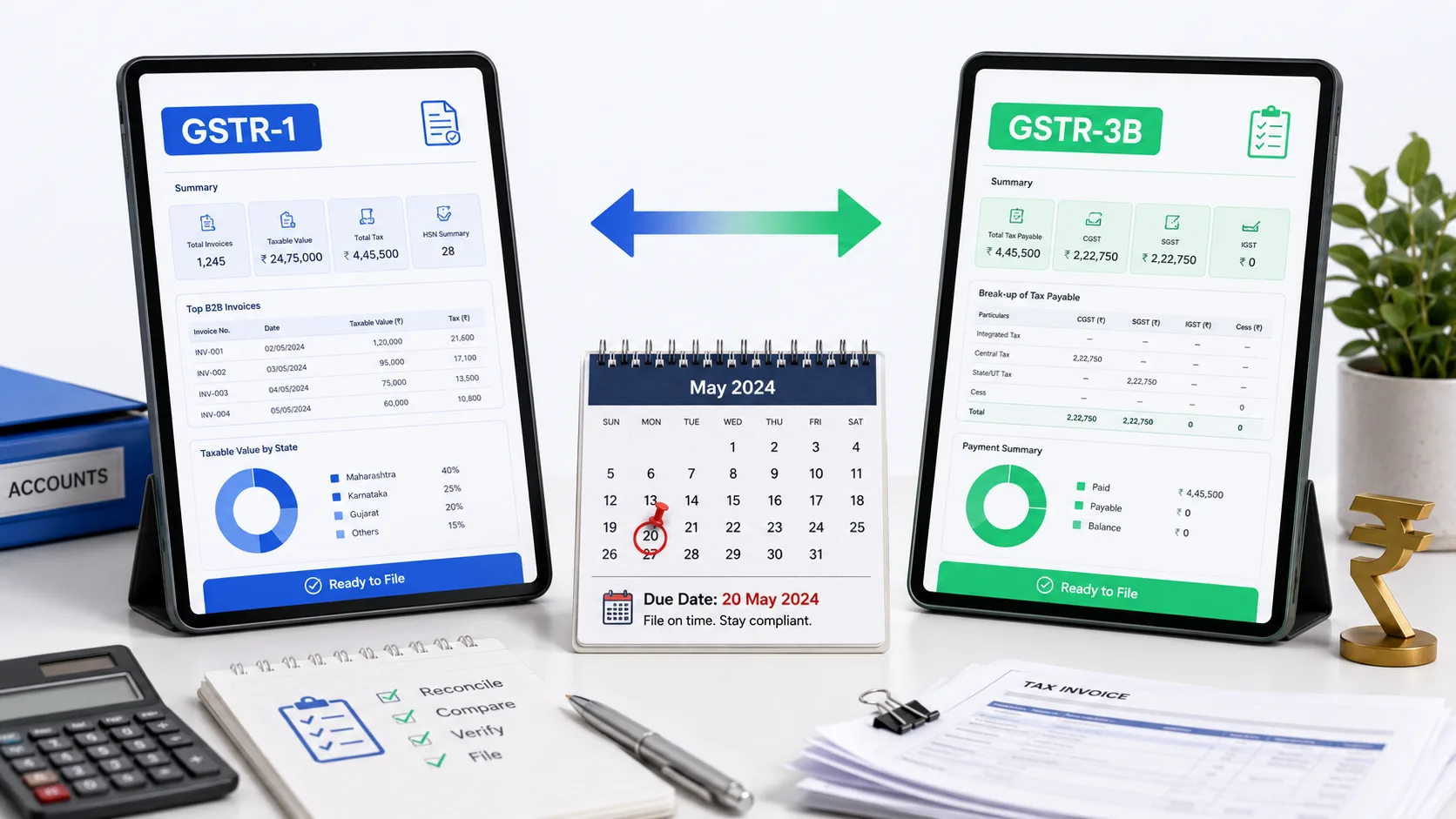
Almost every GST-registered business files two returns a month: GSTR-1 and GSTR-3B. They sound similar, but they do very different jobs — one reports your sales, the other pays your tax. Keeping them consistent is the single best way to stay off the department's radar. This guide explains what goes in each, how they connect through GSTR-2B, the due dates, and how to reconcile them.
- GSTR-1 reports every sales invoice; GSTR-3B is a summary where you actually pay tax.
- GSTR-1 is due by the 11th, GSTR-3B by the 20th of the following month (monthly filers).
- Your GSTR-1 feeds your buyers' GSTR-2B — errors block their input tax credit.
- GSTR-1 and GSTR-3B must reconcile; a mismatch is a common audit trigger.
GSTR-1 vs GSTR-3B at a glance
| GSTR-1 | GSTR-3B | |
|---|---|---|
| Purpose | Report outward supplies (sales) | Summarise and pay net tax |
| Detail level | Invoice-by-invoice | Consolidated totals |
| Tax paid here? | No | Yes |
| Due date (monthly) | 11th of next month | 20th of next month |
| Feeds | Buyers' GSTR-2B | Your electronic ledgers |
GSTR-1: your sales
GSTR-1 is a detailed statement of your outward supplies — every sales invoice, credit note and debit note. It is due by the 11th of the following month (or quarterly under QRMP). The data here flows into your buyers' GSTR-2B, which is how they claim input credit, so accuracy matters to your customers as much as to you. A B2B invoice you forget to report is a credit your customer cannot claim.
GSTR-3B: your tax payment
GSTR-3B is a summary return where you declare total taxable sales, claim your eligible input tax credit (ITC) and actually pay the net tax through your electronic cash or credit ledger. It is due by the 20th of the following month. Unlike GSTR-1, it does not go invoice by invoice — but the totals must agree with what you reported in GSTR-1.
How GSTR-2B fits in
GSTR-2B is an auto-drafted statement of the ITC available to you, built from your suppliers' GSTR-1 filings. Before claiming credit in GSTR-3B, match your purchase register against GSTR-2B. Claiming more than what appears in 2B is the fastest route to a mismatch notice.
The monthly rhythm
- By the 11th: file GSTR-1 (outward supplies).
- Around the 14th: GSTR-2B is generated — reconcile your purchases against it.
- By the 20th: file GSTR-3B (summary and tax payment).
- Quarterly dates and late fees: see GST return due dates.
- Every 3B should follow a GSTR-2B reconciliation so you claim only eligible credit.
“GSTR-1 tells the department what you sold. GSTR-3B pays for it. When those two stories match, GST is quiet.”
Late filing consequences
- Late fee accrues per day for each return until filed, subject to a cap.
- Interest at 18% per annum applies on any tax paid late through GSTR-3B.
- You cannot file GSTR-1 for a period until earlier periods are filed, so delays compound.
No sales in a month? You still file both returns, as nil returns. See how to file a nil GST return.
Frequently asked questions
Can I file GSTR-3B without filing GSTR-1?
The portal now sequences the two — GSTR-1 for a period should be filed before its GSTR-3B, and GSTR-3B cannot be filed if a previous period's return is pending. File them in order.
What if I made an error in GSTR-1?
GSTR-1 cannot be revised, but you can amend the invoice in a later month's GSTR-1 using the amendment tables. Correct it in the next filing rather than leaving a mismatch.
Do nil-return businesses still need to file both?
Yes. Even with no sales, you must file nil GSTR-1 and GSTR-3B for every period, which can be done quickly via SMS or the portal.
You can sanity-check your tax with our GST calculator. If you would rather have a CA reconcile and file both returns every month, that is exactly what our GST return filing service does. Explore all GST services.