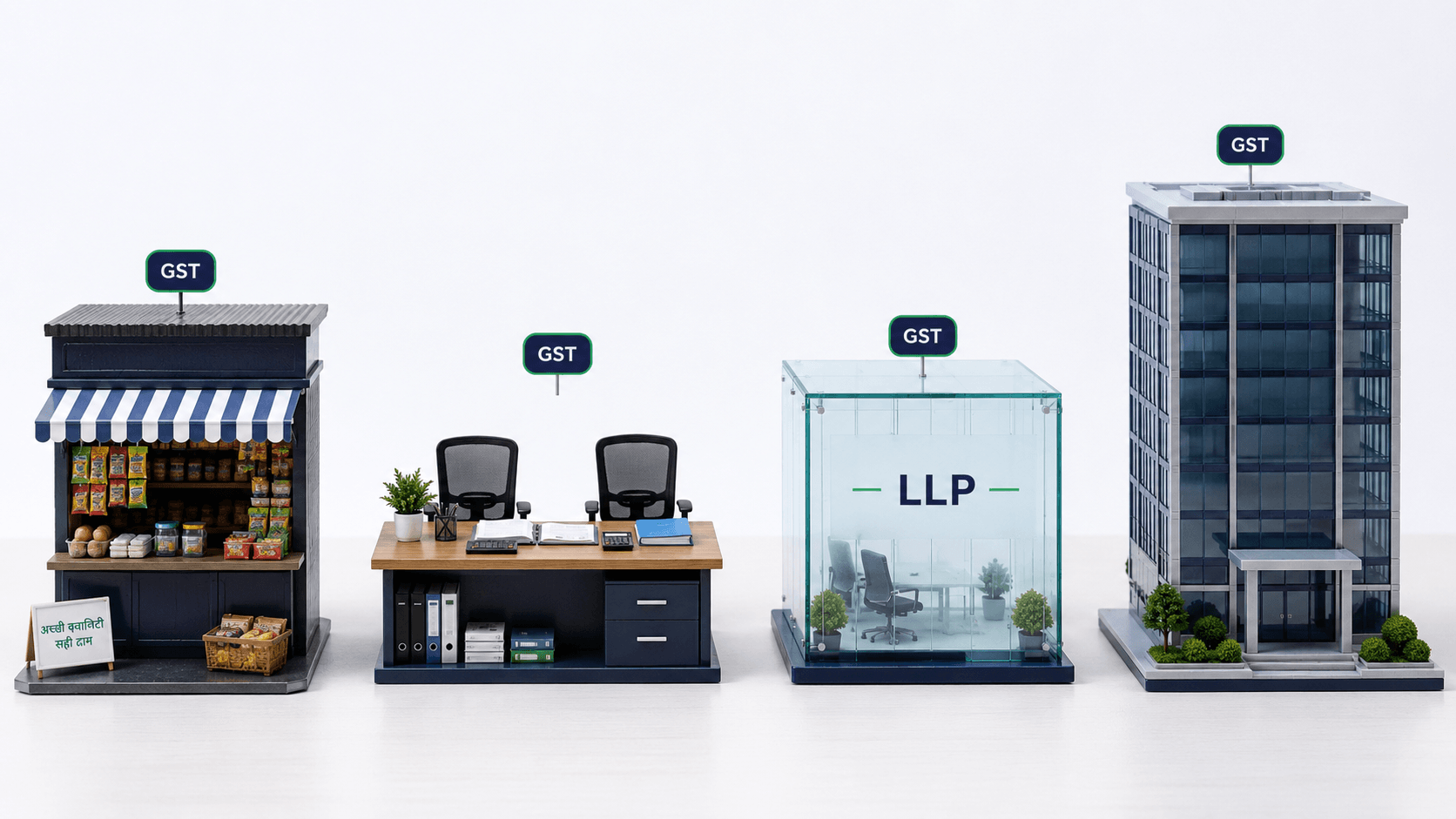
GST registration is the same destination for every business, but the documents, authorised signatories and signing method differ depending on how you are set up. This guide breaks down exactly what a proprietorship, partnership firm, LLP and private limited company each need to register — so you upload the right set the first time.
- A proprietorship registers on the owner's personal PAN; every other structure uses a separate entity PAN.
- Companies and LLPs must sign the application with a Digital Signature Certificate (DSC); proprietors and partnerships can e-sign with Aadhaar OTP.
- The constitution you select on the portal must match your PAN and incorporation documents exactly.
- Address proof, bank details and photographs are required for every structure.
The documents at a glance
| Requirement | Proprietorship | Partnership | LLP / Company |
|---|---|---|---|
| PAN registered on | Owner's PAN | Firm PAN | Entity PAN |
| Constitution proof | None | Partnership deed | Certificate of Incorporation |
| Authorisation | Not needed | Partner authorisation letter | Board resolution / authorisation |
| Signing method | Aadhaar OTP | Aadhaar OTP | DSC (mandatory) |
Proprietorship
The simplest case. The proprietor's PAN is the business PAN, so you register on the individual's PAN with their Aadhaar, address proof and bank details. There is no separate entity document and no DSC — Aadhaar-based e-signing is enough. This makes proprietorship the fastest structure to get a GSTIN.
Partnership firm
A partnership is a distinct entity for GST, so it registers on the firm's own PAN. You will need:
- The firm's PAN and the partnership deed.
- PAN and Aadhaar of all partners.
- A letter authorising one partner as the authorised signatory.
- Address proof of the principal place of business and bank details.
LLP and private limited company
These are the most document-heavy structures because they are separate legal persons governed by the MCA. You will need:
- Entity PAN and the Certificate of Incorporation.
- A board resolution or authorisation letter naming the authorised signatory.
- A Digital Signature Certificate (DSC), which is mandatory for companies and LLPs.
- PAN, Aadhaar and photographs of directors or designated partners.
- For a company, the LLP agreement or MOA/AOA may be requested.
“Companies and LLPs must sign the GST application with a DSC. Proprietors and partnerships can use Aadhaar-based e-signing instead.”
Which structure is easiest to register?
In order of paperwork: proprietorship is the lightest, followed by partnership, then LLP and company (which need incorporation documents and a DSC). But ease of registration should not drive your choice of structure — liability protection, funding plans and credibility matter far more. If you are still deciding, weigh the trade-offs in our comparison first.
Frequently asked questions
Can a proprietor use a personal bank account for GST?
Yes. A proprietorship can use the proprietor's personal current or savings account, since the business and the individual share the same PAN. A dedicated current account is still recommended for clean bookkeeping.
Do all partners need to complete Aadhaar authentication?
Only the authorised signatory needs to authenticate for the application. However, all partners' PAN and Aadhaar details are captured in the application.
Is a DSC really mandatory for a private limited company?
Yes. Companies and LLPs must submit the GST application using a Class 3 DSC of the authorised signatory. Aadhaar OTP signing is not available to them.
Not sure which set applies to you, or still deciding on a structure? Read our guide on LLP vs Private Limited, then let our GST registration experts file it correctly for your entity type. See all our GST services here.