Bookkeeping is the quiet foundation under every other compliance — GST, income tax, audit. Get it right and everything downstream gets easier. Get it wrong and you feel it at filing time, in mismatches and notices. This guide covers the records you must keep, the reports that actually help you run the business, and a monthly routine that makes tax season a non-event.
- Keep invoices, bank statements, expense receipts and a fixed-asset register.
- Reconcile your bank to your books every month, not at year-end.
- Your GST returns and ITR both draw on your books — clean books mean fewer notices.
- Separate business and personal finances from day one.
Records you should maintain
- Sales and purchase invoices, in order and reconciled.
- Bank statements matched to your books every month.
- Expense receipts, categorised for deductions.
- A fixed-asset register and, if registered, GST records.
- Loan, payroll and TDS records where applicable.
The reports that matter
| Report | What it tells you |
|---|---|
| Profit & Loss | Whether you are actually making money |
| Balance Sheet | What you own and owe at a point in time |
| Cash flow | Whether you can pay next month's bills |
| Debtors / creditors | Who owes you and whom you owe |
The monthly routine
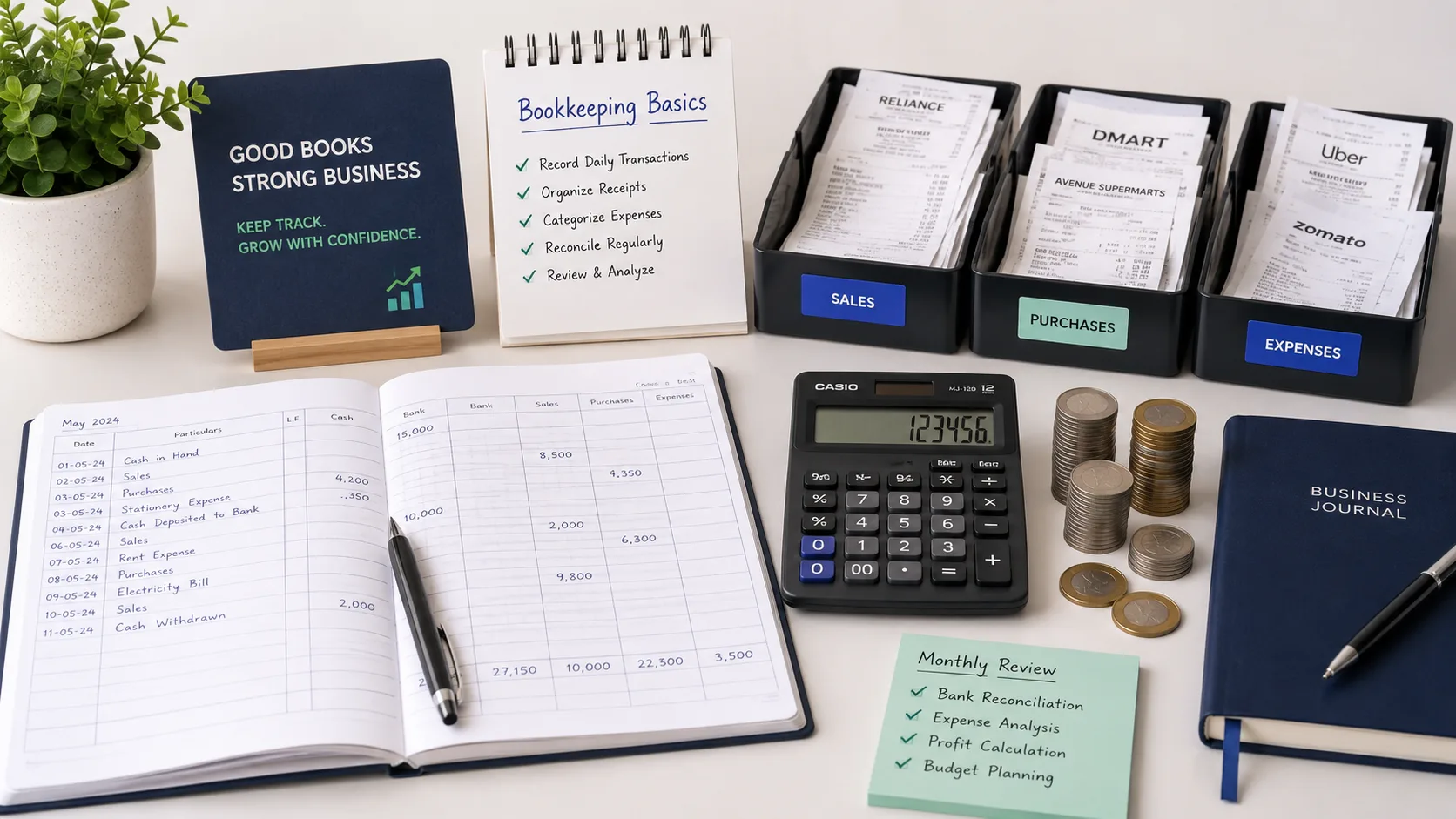
Reconcile your bank, record every invoice, categorise expenses, and review a simple profit-and-loss. Thirty minutes a month prevents the year-end pile-up and surfaces problems — an unpaid invoice, a duplicate expense, a GST mismatch — while they are still small and fixable.
“Good books are not a tax chore you do in March. They are the dashboard you steer the business by all year.”
Frequently asked questions
Do small businesses legally have to keep books?
Beyond certain income and turnover thresholds, maintaining books of account is a legal requirement under the Income Tax Act. Even below them, good records are essential for GST and decision-making.
How long must I keep accounting records?
Generally at least six years, and longer where assessments or disputes are open. Digital copies are acceptable if legible and complete.
Should I use software or a CA?
It depends on your transaction volume — see our comparison of Tally, Zoho or a CA.
Our bookkeeping service keeps your books current and reconciled every month. See all income tax and accounting services.